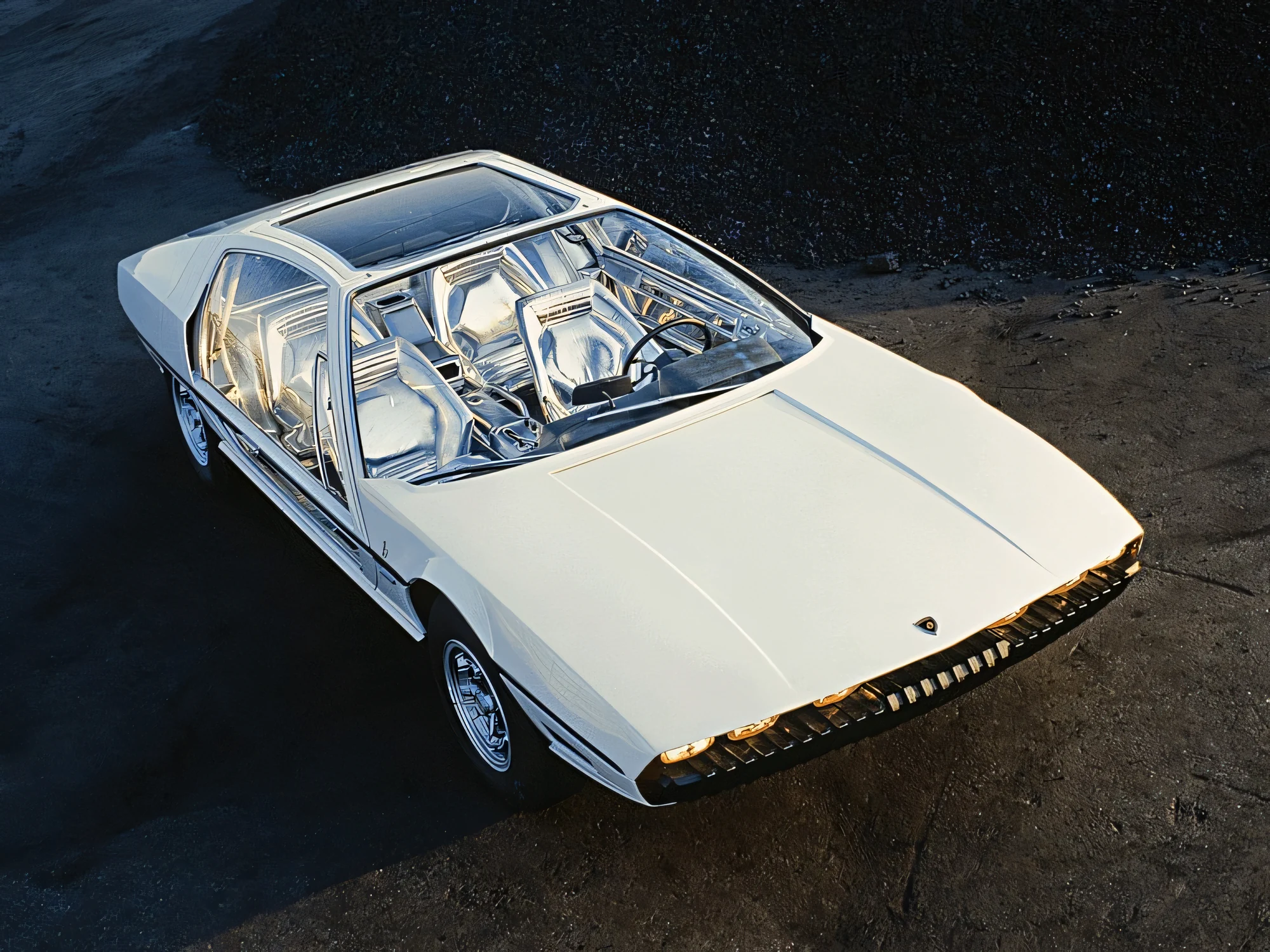
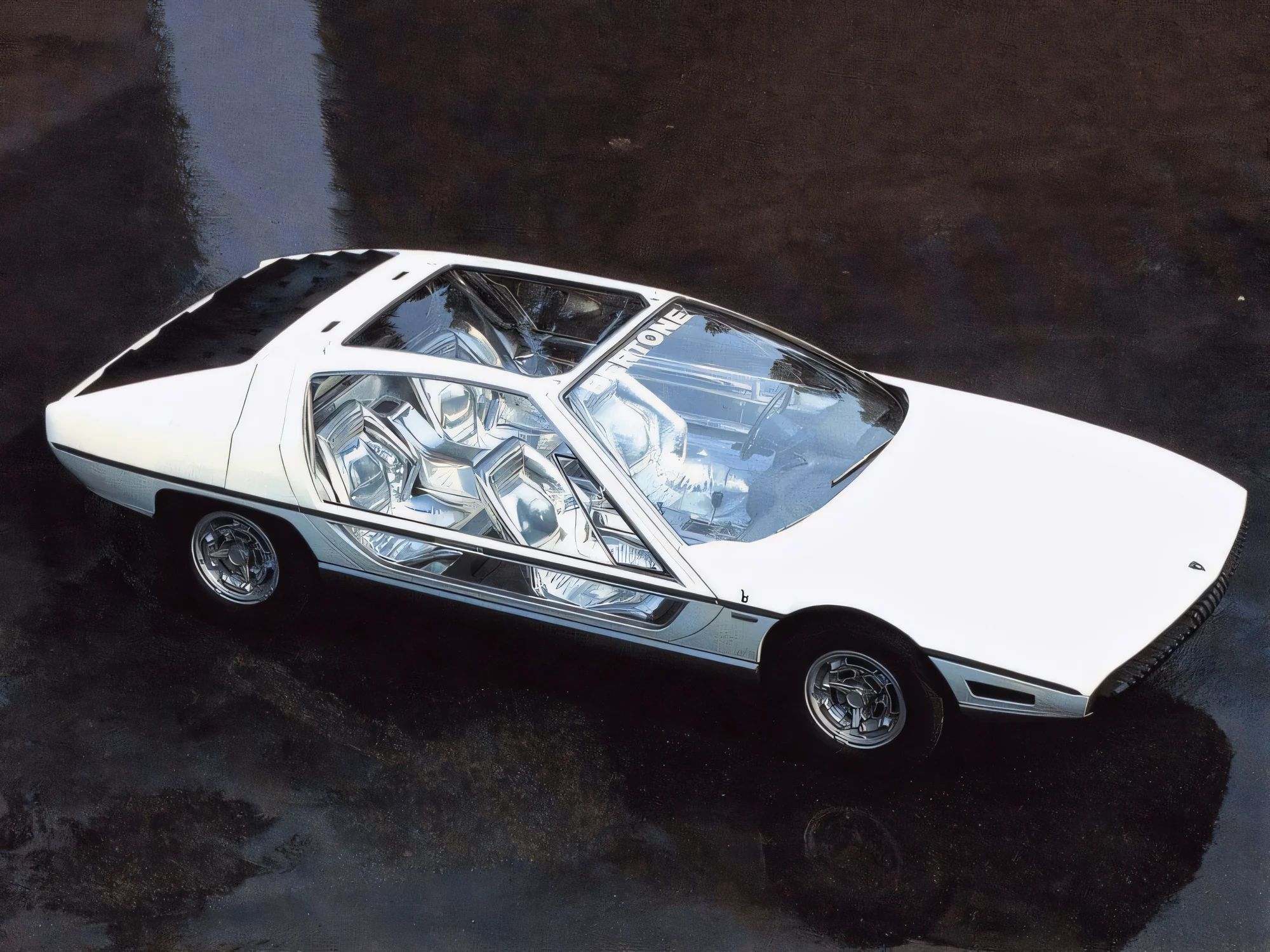
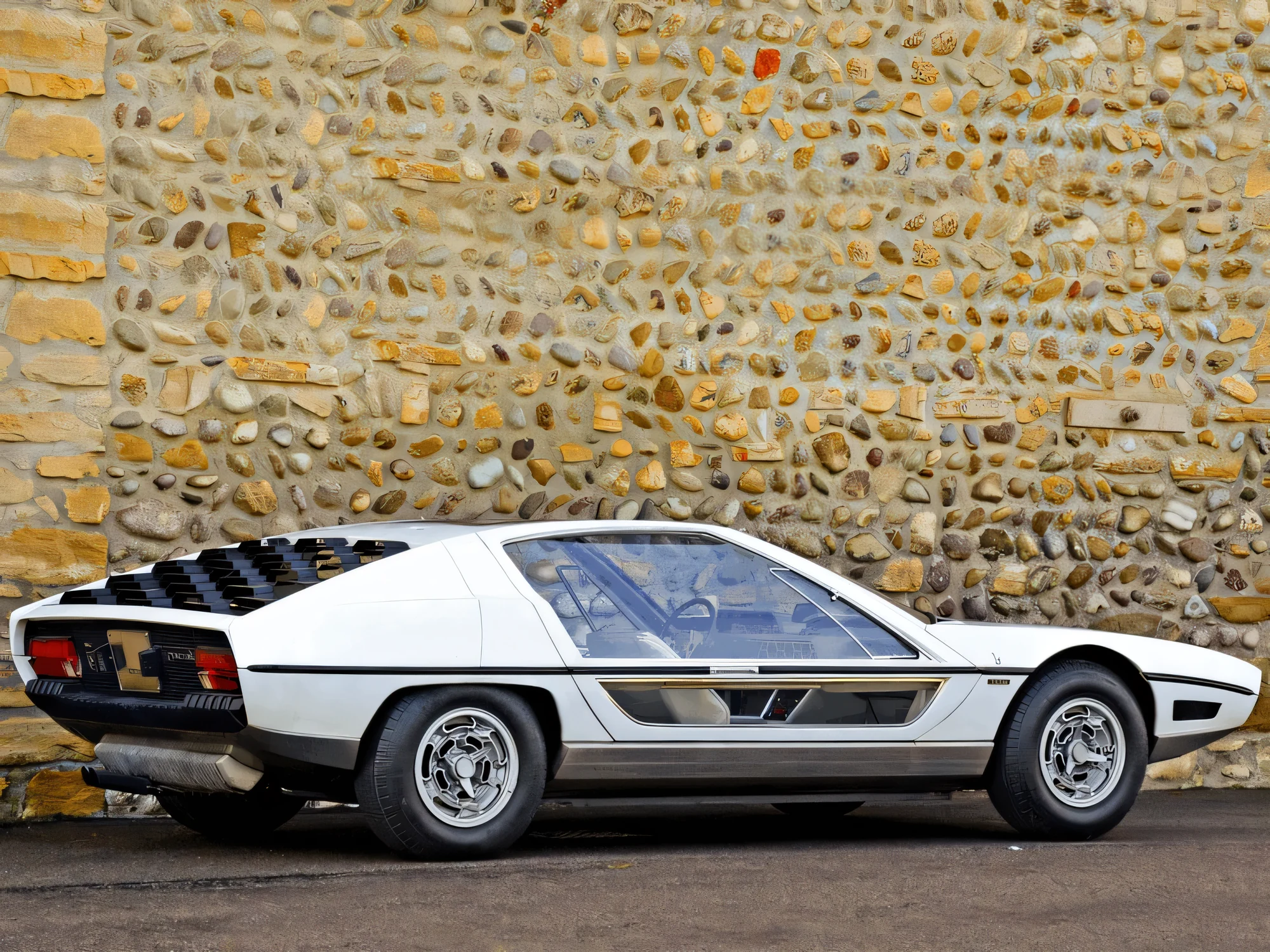
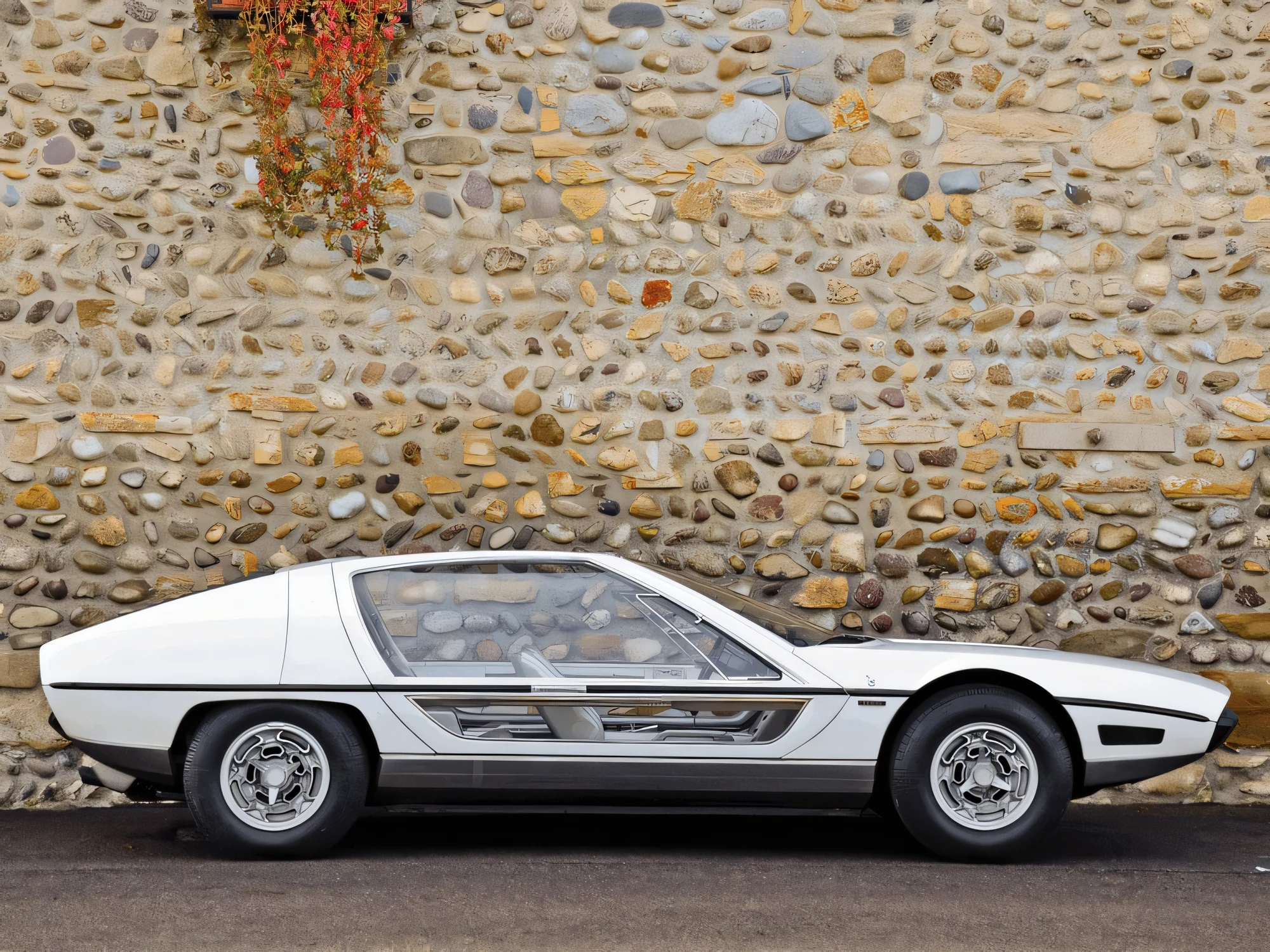
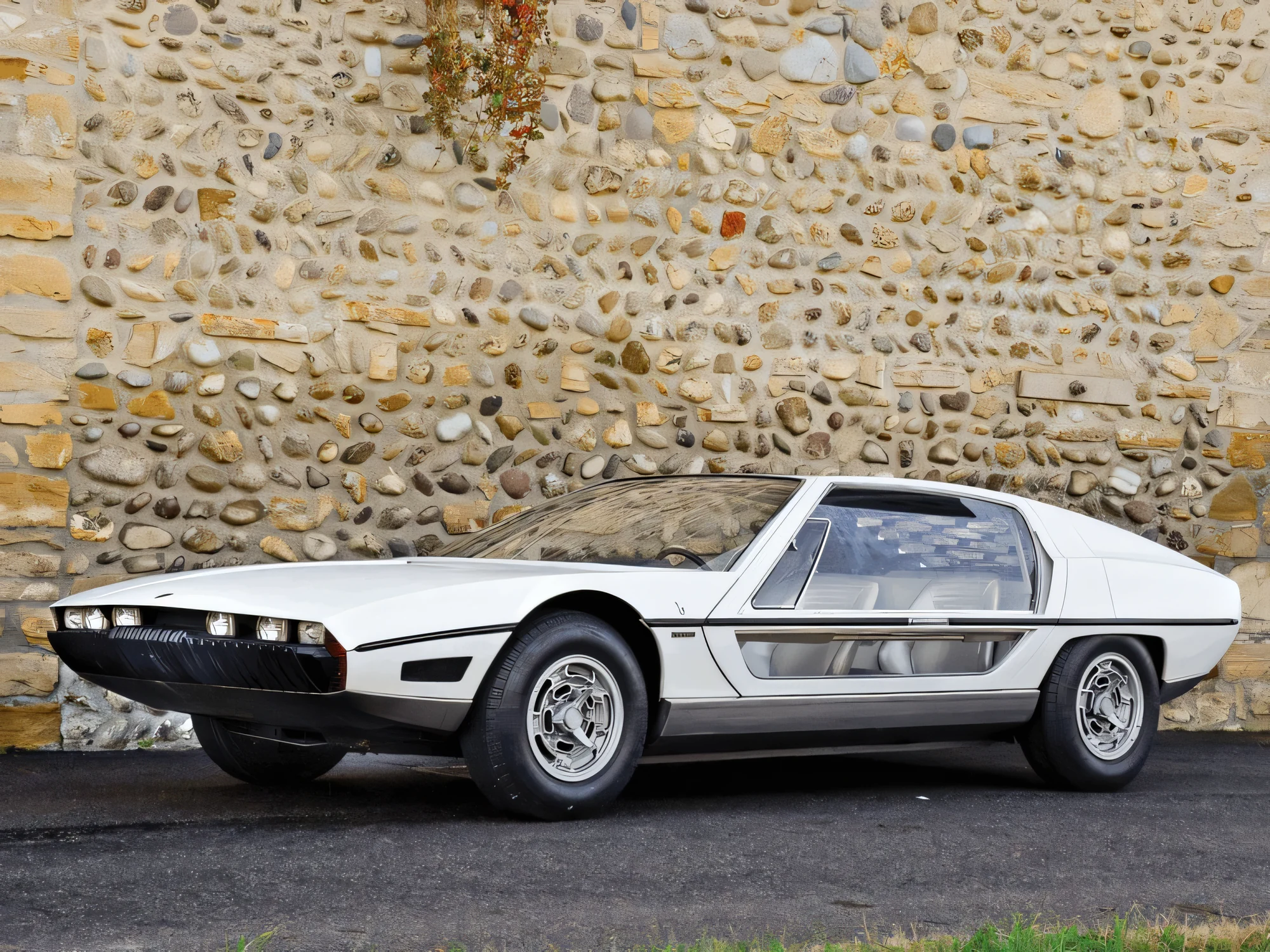
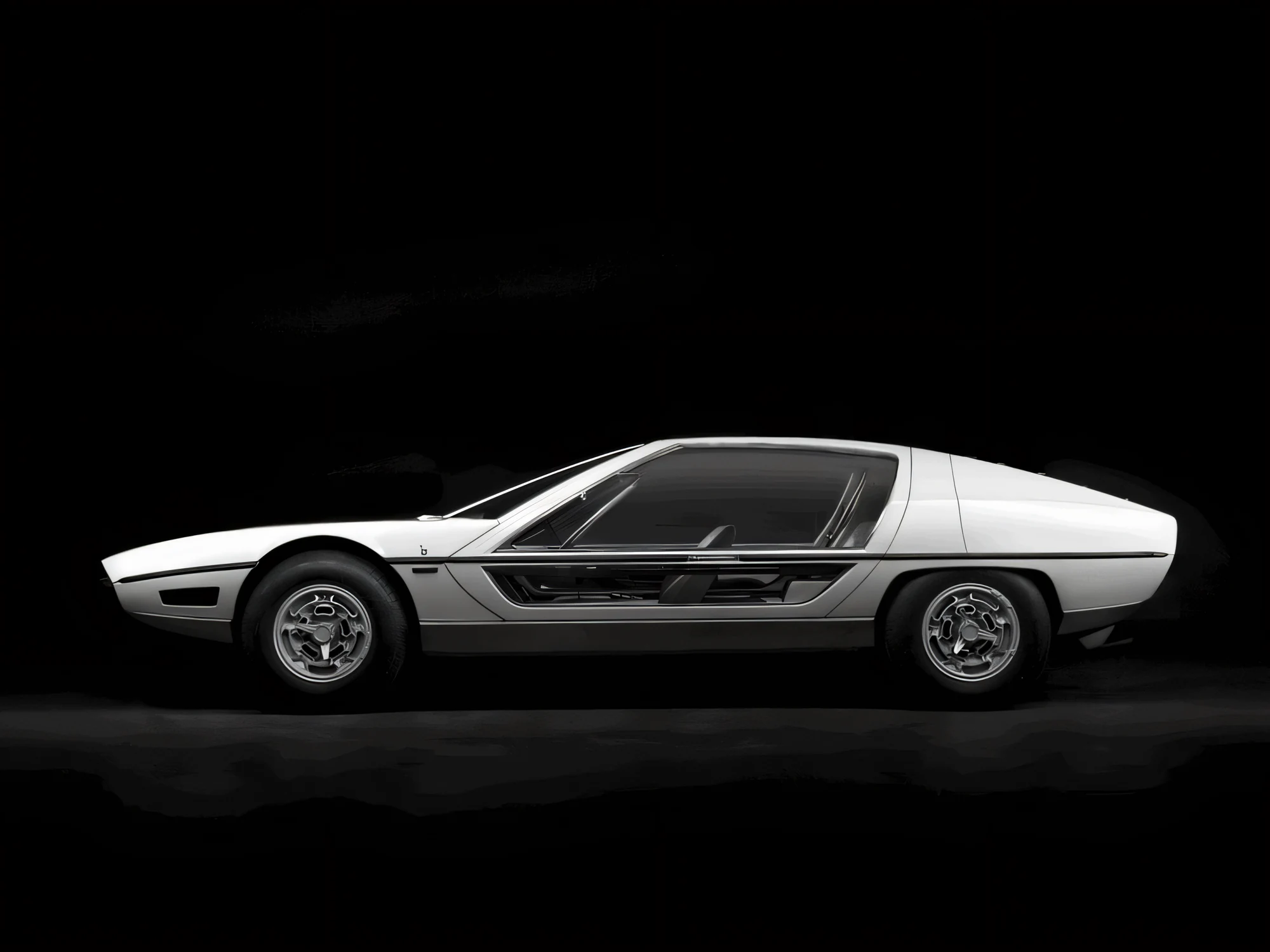
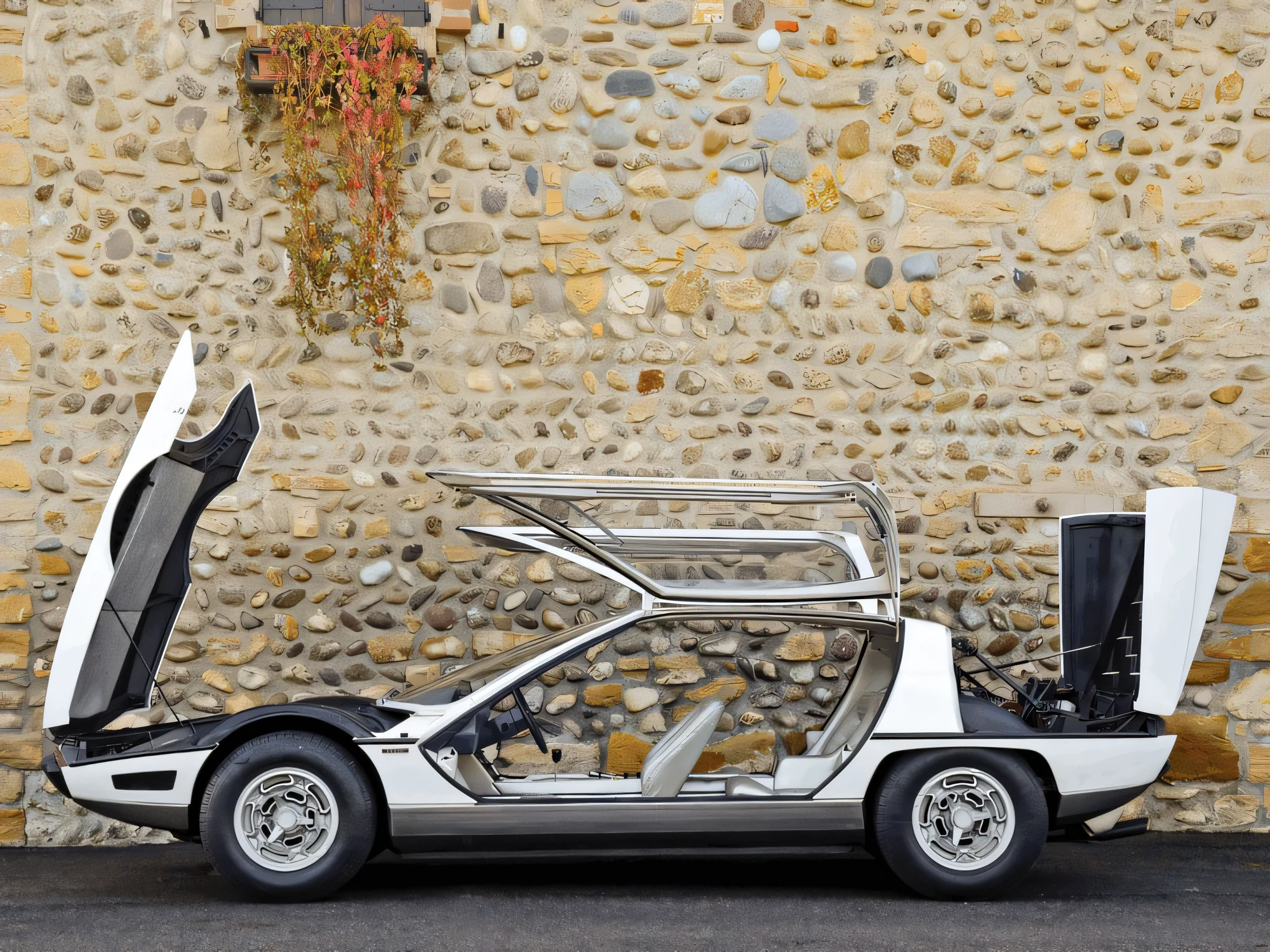
Ferruccio Lamborghini asked for a four-seater. Marcello Gandini gave him a spaceship. The Marzal is a concept car in the truest sense — not a preview of a product but a statement of intent, from a 27-year-old who had just been handed the pen at Bertone and wanted the world to know it. Everything about it is an argument: the glass, the geometry, the hexagons, the engine slung out the back.
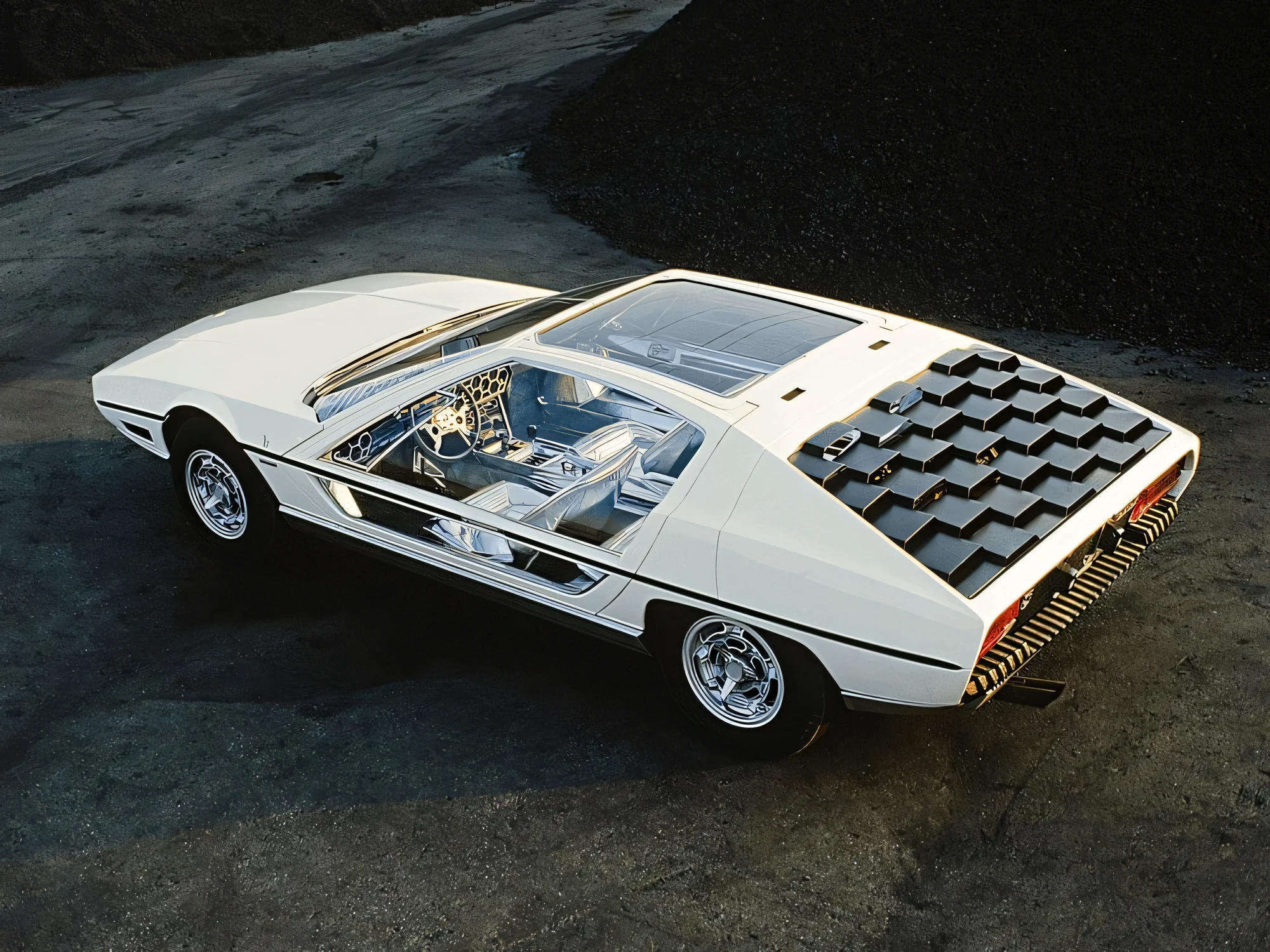
- It's a genuine runner — a Miura chassis stretched to seat four, with a transverse six that is literally one bank of the Miura's V12 mounted behind the rear axle.
- Gandini, 27 and newly in charge at Bertone, used it to launch a language: the hexagon motif and hard geometry that would mark Lamborghini and his own wedge era.
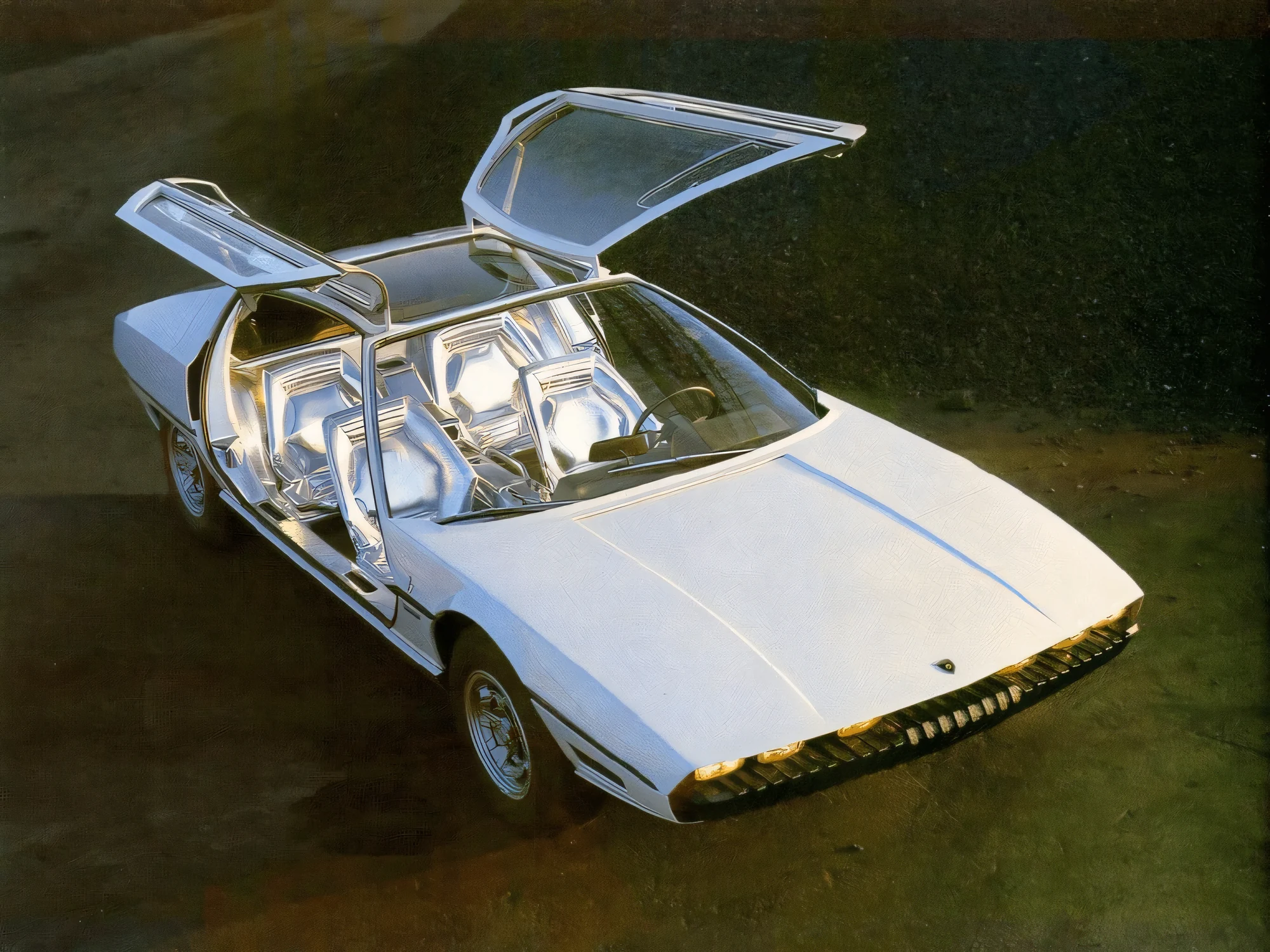
- Its gullwing doors were glazed right down to the sills — so completely that Ferruccio objected you could see a passenger's legs. The production Espada quietly undid all of it.
Most concept cars are sales tools — a way to test a production shape, or to draw a crowd to a
stand. The Marzal is something rarer: a car built to make an argument. Ferruccio Lamborghini had
asked Bertone for a genuine four-seat GT to sit alongside the Miura, and treated the exercise as
advertising more than product. What came back was a glass-and-silver spaceship that said far more
about its 27-year-old designer than about any car Lamborghini intended to sell.
A four-seater, reimagined as a spaceship
The brief was practical; the answer was pure theatre. Where a four-seat GT would normally mean
compromise — more metal, more mass, less drama — Gandini went the other way entirely, dissolving
the car’s sides into glass and lifting the roof off on a pair of enormous gullwing doors. The point
wasn’t practicality. It was to show that a big Lamborghini could be as radical as a small one, and
that the man now drawing them had ideas of his own. The specific gestures — the doors, the hexagons,
the greenhouse — are catalogued above; what matters is that they all pull in one direction, toward
lightness and geometry and spectacle.
Half a Miura, slung out the back
The engineering is as unconventional as the body, and just as economical an idea. Rather than
commission a new engine for a one-off, Lamborghini took essentially one bank of the Miura’s V12 — a
transverse straight-six — and hung it behind the rear axle of a stretched Miura chassis. It made the
Marzal a true running car rather than a styling buck, and it’s a neatly Lamborghini solution: the
most exotic thing in the range, halved, to power the most experimental car it ever showed. The
numbers are in the panel above, and they carry the usual concept-car asterisk — claimed, never tested.
The statement outlived the car
The Marzal was never going to be built, and everyone involved knew it. Its job was to say something,
and it did — loudly enough that its ideas kept surfacing for decades. The production four-seater it
led to was tamer by design. But the language it launched wasn’t: the hard geometry became the wedge
era, the hexagon became a house signature, and the young designer became the man who drew the
Countach. A concept car’s real output isn’t a product. It’s an influence — and by that measure the
Marzal is one of the most productive cars Lamborghini never made.
The design language
The cues that make it what it is — and why each one was drawn that way.
The doors Glass gullwings, glazed to the sill
Full-height gullwing doors, glazed almost in their entirety — including the lower halves — so occupants were visible from the waist down. Ferruccio Lamborghini's own objection gives it away: a lady's legs, he complained, would be 'there for all to see'. It's the single most radical thing on the car, and the first thing the production Espada deleted.
The motif Hexagons, obsessively
A honeycomb theme runs through the entire car — the dashboard, the seat cushions, the steering wheel, the aluminium-slat rear deck and its hexagon-pierced louvres, even the Campagnolo magnesium wheels. It didn't stay a one-off flourish: hexagonal detailing became a recurring Lamborghini cue and still turns up today, decades later, on cars like the Aventador.
The greenhouse Roughly 4.5 m² of glass
Minimal pillars, a lightly-smoked glass roof and an almost impossibly airy cabin — a space-age greenhouse trimmed in silver leather, described at the time as a gem set into a futuristic white bezel. The Marzal's whole character is light and transparency where a supercar would usually be low and hunkered.
The nose The wedge, forming
A low, sharply-cut wedge nose carrying six square Marchal headlamps — angular, geometric, hard-edged. You can see Gandini working out the language here that would become the Carabo and the Countach: the wedge era starts, quietly, on this car's front end.
The afterlife What became of it — the Espada, and a lap of Monaco
The four-seat GT that Ferruccio actually wanted arrived a year later as the Lamborghini Espada (1968). It carried the Marzal's shape and much of its thinking into production — but with the arguments settled: the rear engine gone, the glass gullwings replaced by ordinary doors, the vast glazing toned right down. The Espada then sold, successfully, until 1978.
The Marzal's own moment came on 7 May 1967, when Prince Rainier III of Monaco drove it on the opening parade lap of the Monaco Grand Prix, Princess Grace beside him — a one-off show car pressed into service as the most glamorous pace car imaginable.
Then it simply… stayed. Bertone kept the Marzal for decades, a fixture of its design collection, until the studio's collapse sent it to auction: RM Sotheby's, Villa d'Este, 2011, where it sold for €1,512,000. A fitting number for a car whose real value was never the metal, but the ideas it let loose.
Design deep cuts
Was the Marzal actually a running car, or just a styling model?
It runs. The Marzal was built on a real Miura chassis stretched by about 120 mm to make room for four seats and a rear-slung engine — a genuine, driveable Miura derivative, not a static pushmobile. Prince Rainier III drove it under its own power on the opening lap of the 1967 Monaco Grand Prix.
What engine did it use — and is it true it's "half a Miura"?
Yes, quite literally. Rather than build a new engine, Lamborghini took essentially one bank of the Miura's 3,929 cc V12 — a 1,964 cc inline-six — and mounted it transversely behind the rear axle, fed by three Weber carburettors, with a claimed 175 bhp. Because this was a one-off show car, that figure is a period manufacturer claim, never independently road-tested.
Why are there hexagons all over it?
It was Gandini's chosen motif, and he ran it everywhere — the dashboard, the seats, the steering wheel, the rear louvres and the wheels all carry the honeycomb theme. Far from a gimmick, it stuck: hexagonal detailing became a lasting Lamborghini signature that still appears on the brand's modern cars, and the Marzal is effectively its origin point.
Did the Marzal lead to a production car?
Directly. The four-seat GT idea reached production as the Lamborghini Espada in 1968, which carried over the Marzal's general shape and much of its thinking — but dropped the rear-engine layout and the glass gullwing doors, and toned the vast glazing right down. The Espada then sold until 1978.
Why did Ferruccio Lamborghini object to the doors?
Because they were glazed all the way down to the sills, a passenger's legs were on full view from outside — Ferruccio felt it offered no privacy. It's a telling clash: the boss wanted a usable four-seat GT, and his young designer had drawn a rolling glass sculpture. The production Espada resolved the argument in Ferruccio's favour.
Where is the Marzal now, and what is it worth?
The one-off was kept by Bertone for decades, long displayed in its design collection, before selling at RM Sotheby's Villa d'Este sale in 2011 for €1,512,000 including premium. As a unique, historically pivotal Gandini/Bertone concept, it's effectively priceless in significance — the auction result just put a number on it once.
More from the drawing board