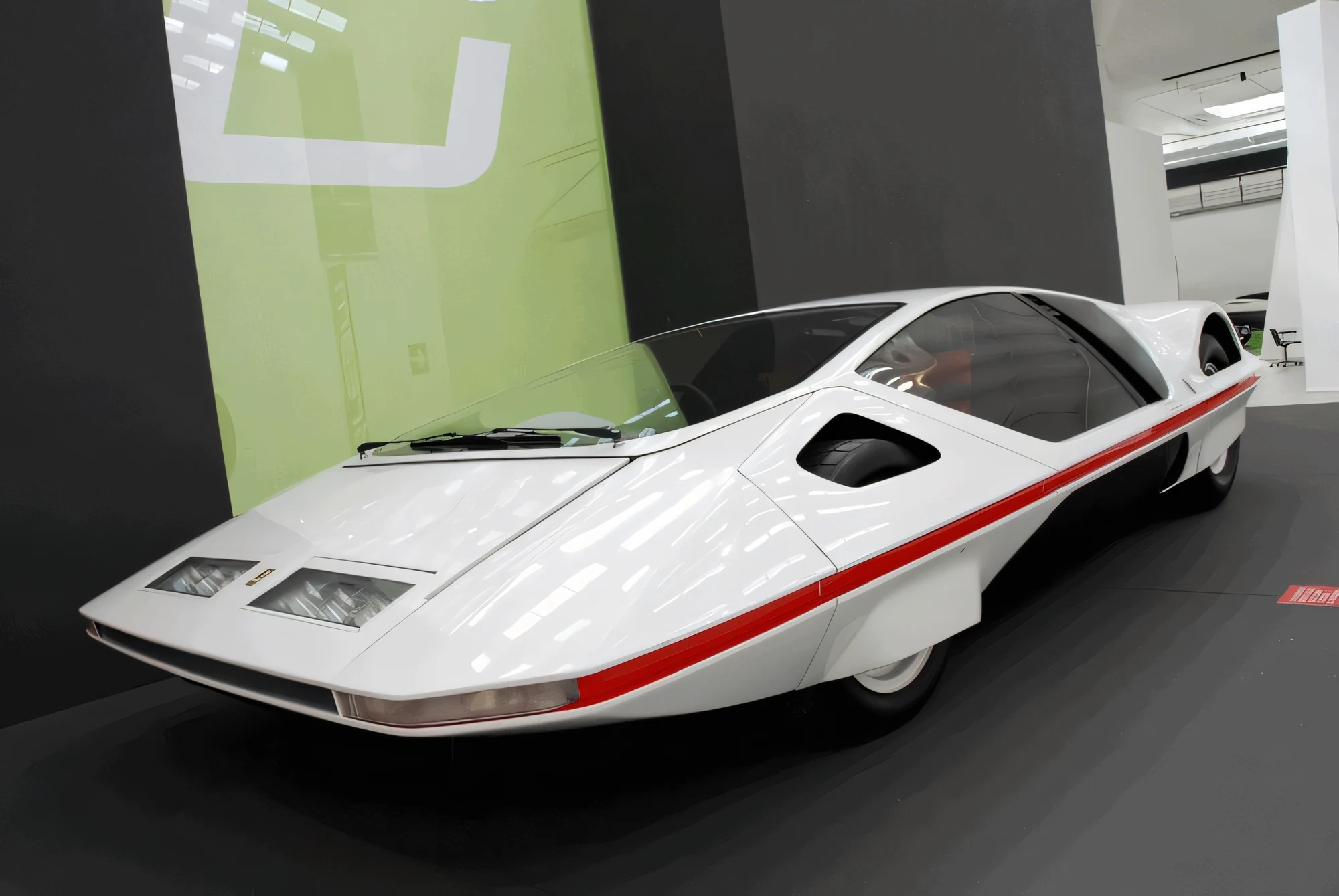
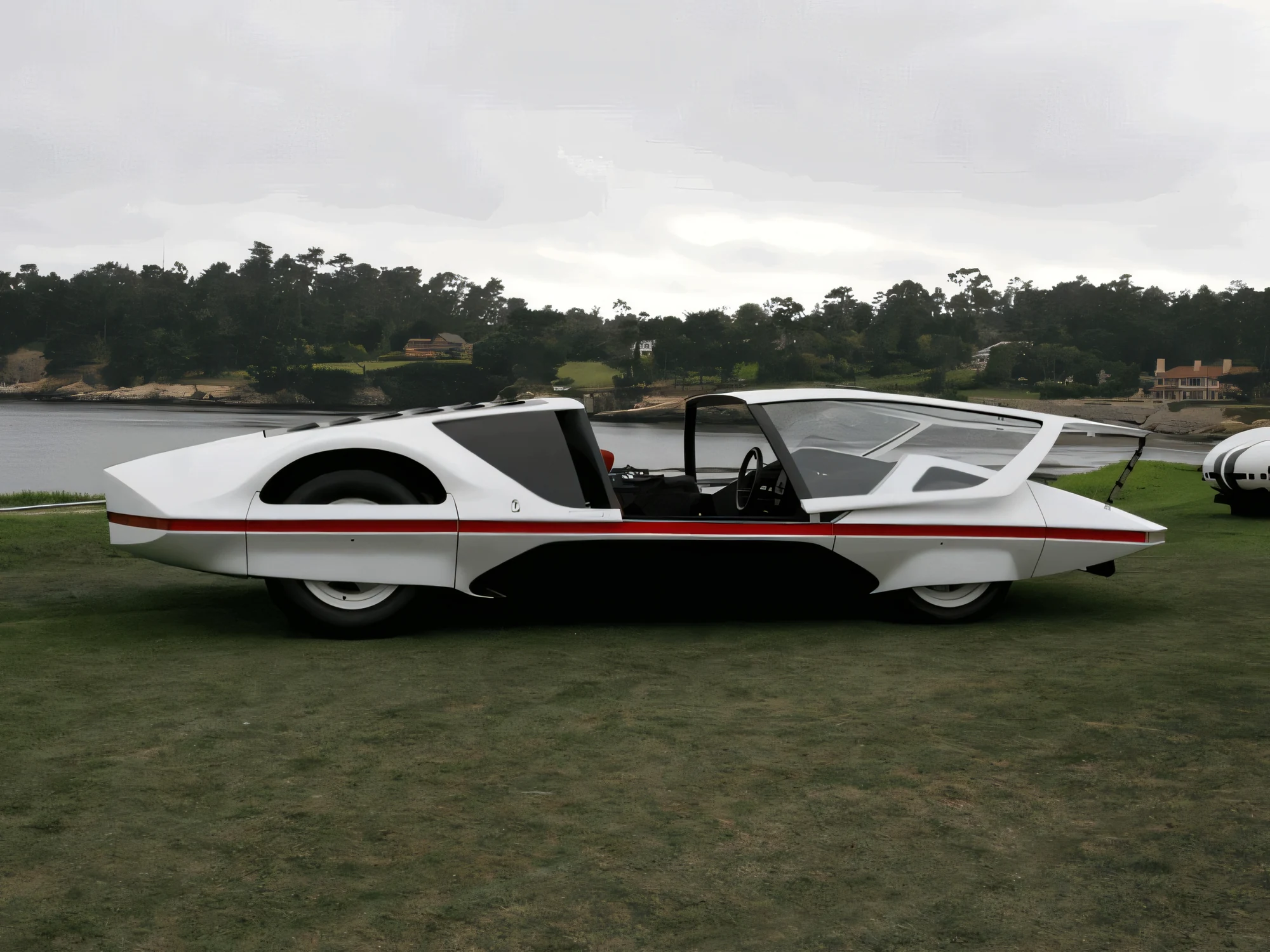
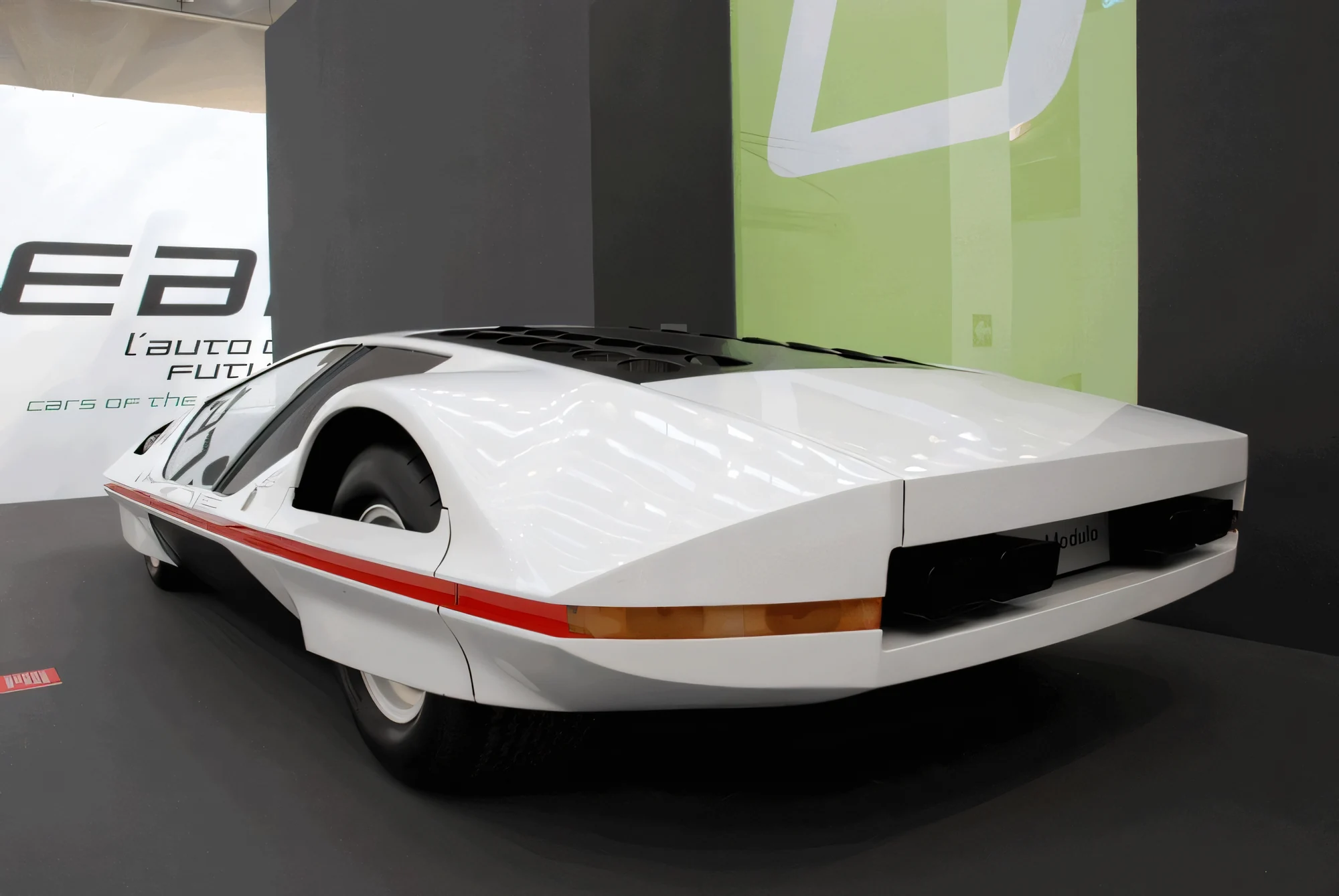
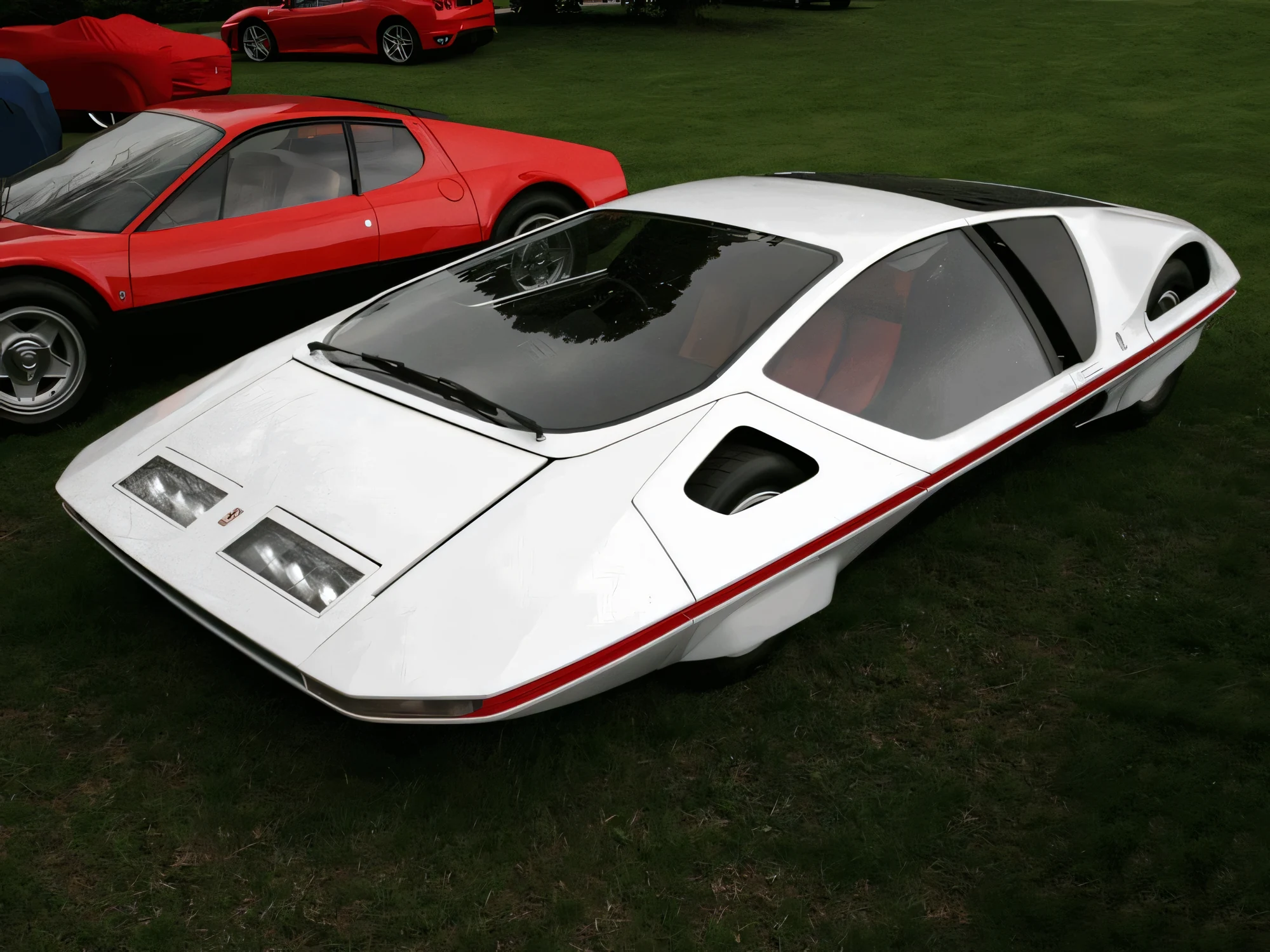
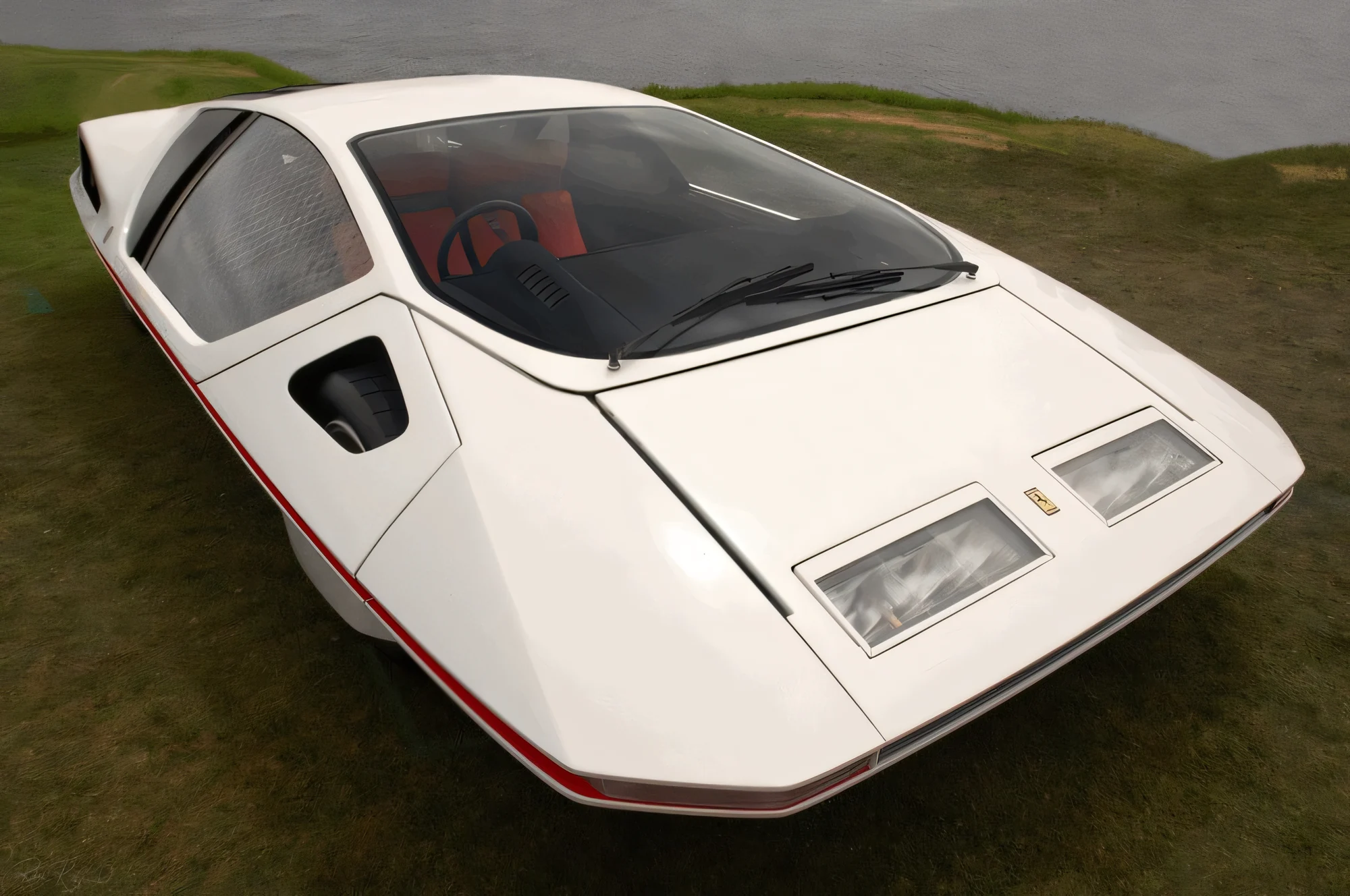
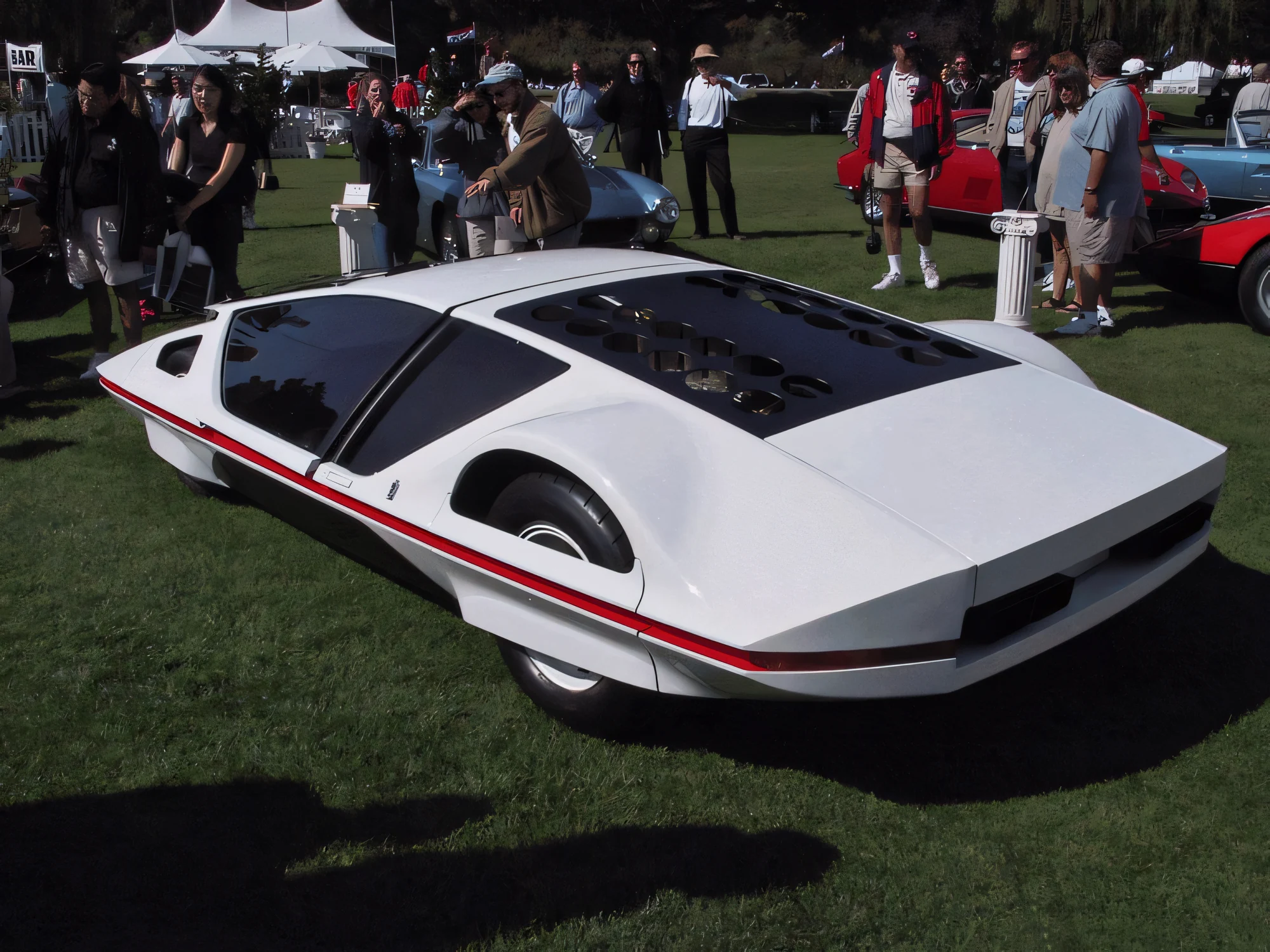
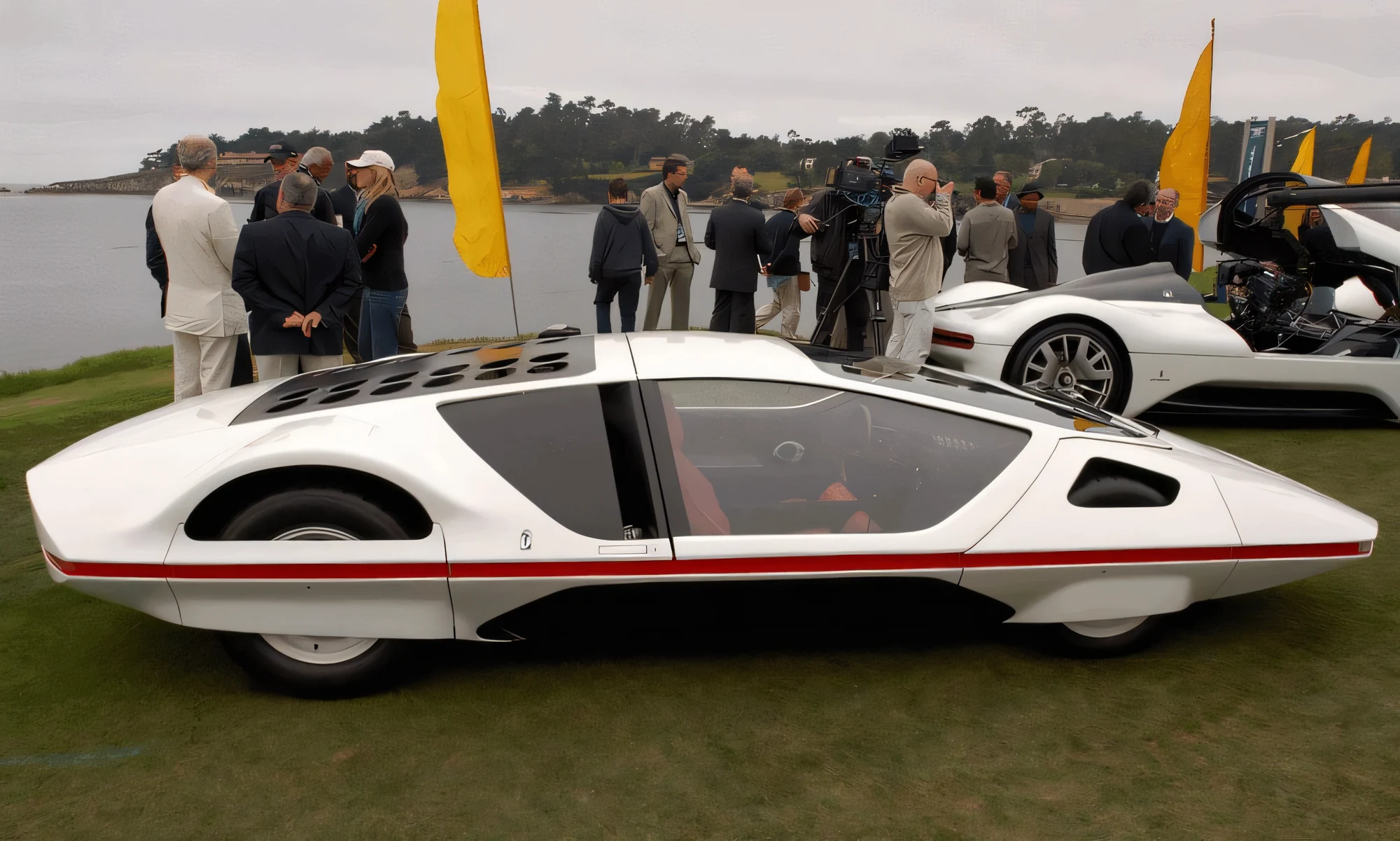
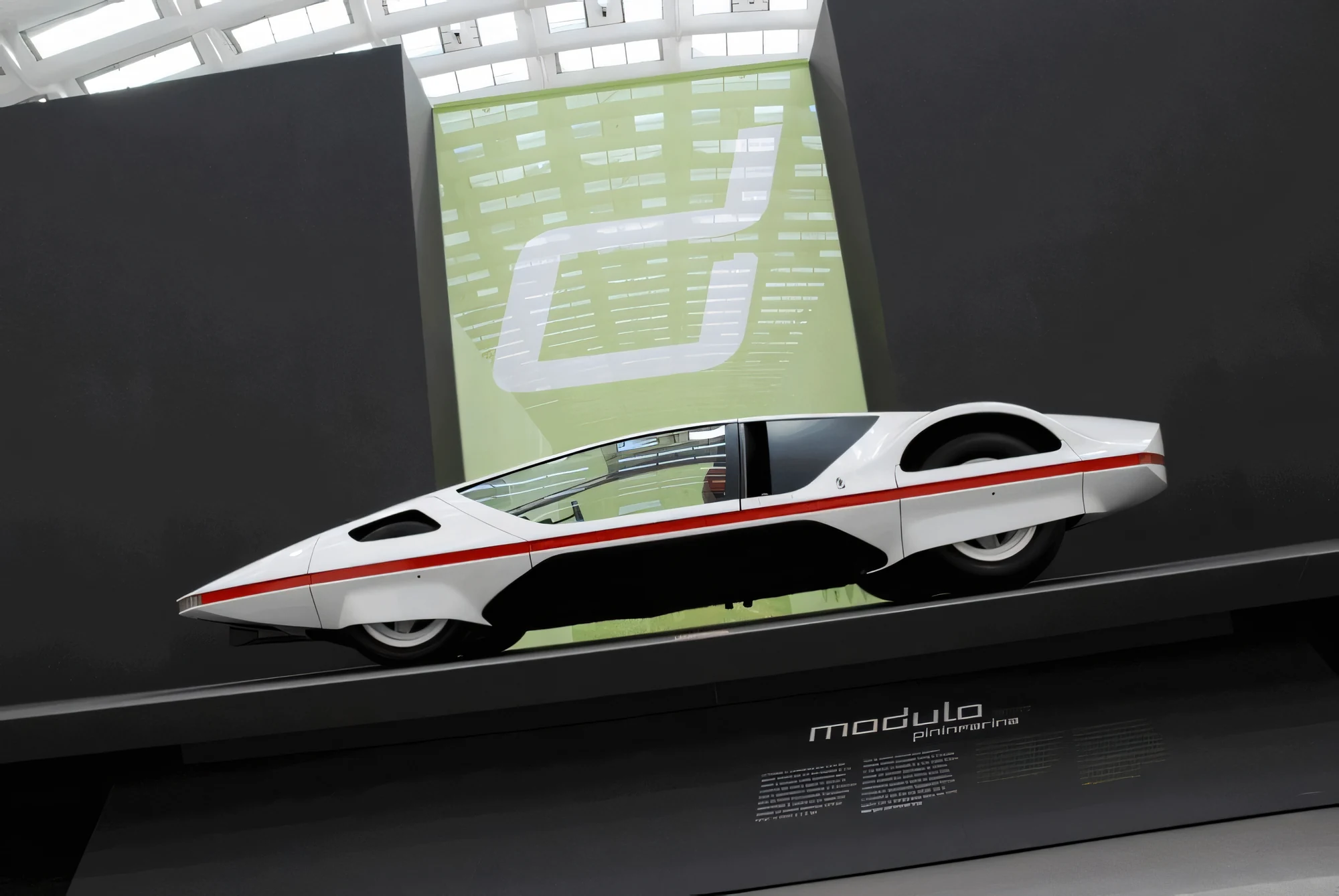
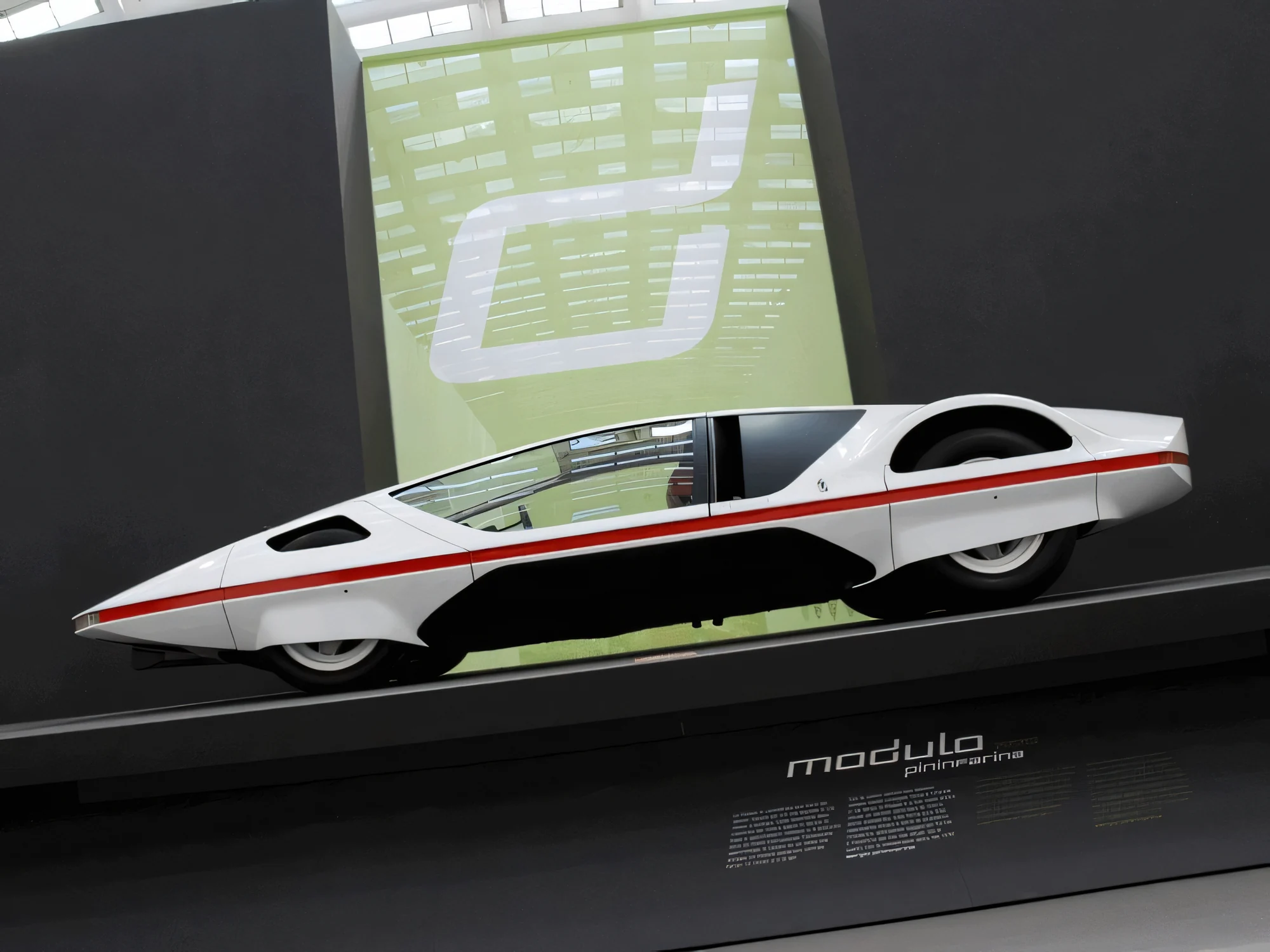
The Modulo is the moment the concept car stopped pretending to be a car at all and became pure sculpture. Paolo Martin took a genuine Ferrari Le Mans racer, buried it under a white flying saucer split by a single seam, sealed the wheels inside the bodywork and did away with the doors entirely. It is arguably the most extreme shape ever built on a real racing chassis — and, for the same reasons that make it extraordinary, it could barely move.
- It's a Le Mans race car underneath — a genuine Ferrari 512S sports-racer chassis with a 5.0 V12 — wrapped in a flying saucer.
- There are no doors: the entire glass canopy slides forward over the nose to let you in, and the body is two shells clamped along a seam that runs right around the car.
- It couldn't actually steer — the enclosed wheels barely turned — so it sat static for 40-plus years, until James Glickenhaus bought it in 2014 and finally made it drive in 2018.
Every concept car in this series argues that a design idea matters more than the product it becomes.
The Modulo is the one that took the argument to its absolute conclusion. Paolo Martin was handed a
real Ferrari 512S — a Le Mans-class racing car — and instead of dressing it up, he entombed it in a
white flying saucer that could barely function as a vehicle. It is the most extreme thing in this
whole file, and it earned the position honestly.
A race car, dressed as a UFO
The contrast is the entire point. Underneath the serene, alien shell sits some of the most brutal
racing hardware of its day: a genuine 512S competition chassis and a 5.0-litre V12. Pininfarina
could have built the Modulo on anything; putting it on a real racer is what gives the car its
tension — the most violent machinery of 1970, wrapped in the calmest, strangest surface anyone had
drawn. The specific moves that make the surface work are catalogued above; what matters is that they
all serve one goal, which is to make a Ferrari look like it landed rather than drove in.
The most beautiful car that couldn’t turn
The Modulo’s great feature and its great flaw are the same thing. Sealing the wheels inside the
bodywork is what gives it that seamless, wheel-less look — and it’s also what left the front wheels
unable to turn, so the car could roll forward and back but not steer. It is the purest example in
this series of design winning an argument with engineering outright. Martin knew, and built it
anyway; for a car whose only job was to be looked at, being unforgettable beat being usable.
Sculpture first, machine later
For most of its existence the Modulo wasn’t really a car at all — it was a sculpture that happened to
have a chassis. That inversion is what makes it the defining object of this whole series: most
concept cars are machines carrying an idea, but the Modulo is an idea that a machine was made to
carry, and only reluctantly. The shape came first, and complete; everything mechanical about it —
including, eventually, the ability to move at all — had to catch up to a drawing that was never
going to compromise. It is design given the final word.
The designer Paolo Martin, and the saucer he built at night
Paolo Martin, born in Turin in 1943, had already passed through Michelotti and Bertone — the house that drew this file's Carabo and Marzal — before joining Pininfarina, where he became chief of styling in 1968. The Modulo was, by his account, a side-project: he conceived it while styling the Rolls-Royce Camargue and built the full-scale model working nights, over Sergio Pininfarina's mild objection that the sketches were 'too futuristic'.
What makes Martin interesting is his range. The same hand that drew this — the most extreme geometric object of its era — also drew the Fiat 130 Coupé, a masterclass in crisp, restrained, razor-edge elegance, and the Rolls-Royce Camargue, the first Rolls styled by an outside Italian house. Spaceship futurism and disciplined production refinement, from one designer.
The Modulo is the futurist pole of that range taken as far as it could go — a design so committed to its own logic that it stopped worrying about being drivable. For a one-off show car, Martin decided, being unforgettable mattered more than being usable.
Also from Martin Fiat 130 Coupé1971Rolls-Royce Camargue1975Lancia Beta Montecarlo1975Peugeot 1041972
The design language
The cues that make it what it is — and why each one was drawn that way.
The body Two shells, one seam
The defining device: the body reads as two separate shells — an upper and a lower — clamped together along a continuous horizontal seam that runs the whole way around the car, picked out as a line in the paint. Nothing else looks like it; the Modulo appears less styled than assembled from two halves of something larger.
The entry You get in by sliding the roof
There are no doors. To get in, the entire glazed canopy slides forward, over the front of the car — a single dramatic gesture that replaces every door, window and pillar a normal car would need. It is as impractical as it is spectacular, which is rather the point of the whole machine.
The wheels Wheels sealed inside the body
All four wheels are enclosed by the bodywork, leaving only a slot exposed — the cue that gives the Modulo its seamless, wheel-less flying-saucer look. It's also its downfall as a vehicle: the enclosing panels left the front wheels barely able to turn, so the car could roll straight but not properly steer.
The details 24 holes and two spheres
Two signatures finish it. The engine cover is drilled with a grid of 24 round holes that reveal the V12 beneath. And inside, the main controls sit in two rotating spheres — a piece of pure spaceship theatre Pininfarina famously never bothered to explain.
The afterlife From static sculpture to street-legal
The Modulo won 22 international design awards, and then, for over forty years, did almost nothing — a non-running showpiece Pininfarina kept as a jewel. That changed in 2014, when the American collector and film-maker James Glickenhaus bought it and set out to do the one thing it had never done: drive.
After about four years of re-engineering — the sealed wheels and near-useless steering were the hard part — the Modulo turned a wheel under its own power for the first time in June 2018. Glickenhaus then had it road-registered in New York, where the paperwork classes the flying saucer, deadpan, as a '1970 Ferrari sedan'.
Its influence never needed the wheels to turn. The Modulo's language of sealed surfaces and hard geometry echoes through the wedge supercars that followed it — the Countach and the Testarossa among them — and it remains, by common consent, one of the most extreme and most celebrated concept cars ever built.
Design deep cuts
Was the Modulo ever a running car?
Not for most of its life. Because the wheels were sealed inside the bodywork, the front wheels could barely turn — the car could roll straight but not actually steer — so it spent more than four decades as a static showpiece. It was only made to genuinely run and drive after collector James Glickenhaus bought it in 2014, reaching its first real drive in June 2018.
How do you get into it — where are the doors?
There aren't any. The entire glass canopy slides forward over the nose of the car to let occupants in and out. It's one of the most theatrical entry mechanisms ever built, and part of why the Modulo reads as a sealed object rather than a conventional car.
What's actually underneath it?
A genuine Ferrari 512S sports-racer — chassis number 27, a spare from the Can-Am homologation batch, supplied by the Ferrari factory — carrying a mid-mounted 5.0-litre V12 with a claimed output of around 550 hp. So one of the wildest design studies ever made sits on a real Le Mans-era racing car. As a one-off concept, its performance figures are period claims, never independently tested.
Why is the body split into two halves?
That seam is the Modulo's defining idea. The body is designed as two shells — an upper and a lower — meeting along a single horizontal line that runs right around the car and is highlighted in the paintwork. It makes the car look assembled from two pieces of a larger whole, and it's the feature every later homage borrows first.
Who designed it, and what else did they do?
Paolo Martin, chief of styling at Pininfarina. His range is the interesting part: the same designer responsible for this spaceship also drew the crisp, restrained Fiat 130 Coupé and the Rolls-Royce Camargue — proof he could do radical geometry and disciplined elegance with equal authority.
Does it really run now, and where is it?
Yes. James Glickenhaus bought the Modulo in 2014 and had it re-engineered to run and drive, taking it out under its own power for the first time in June 2018 and later registering it for the road in New York — where the paperwork, wonderfully, classes the flying saucer as a '1970 Ferrari sedan'.
More from the drawing board