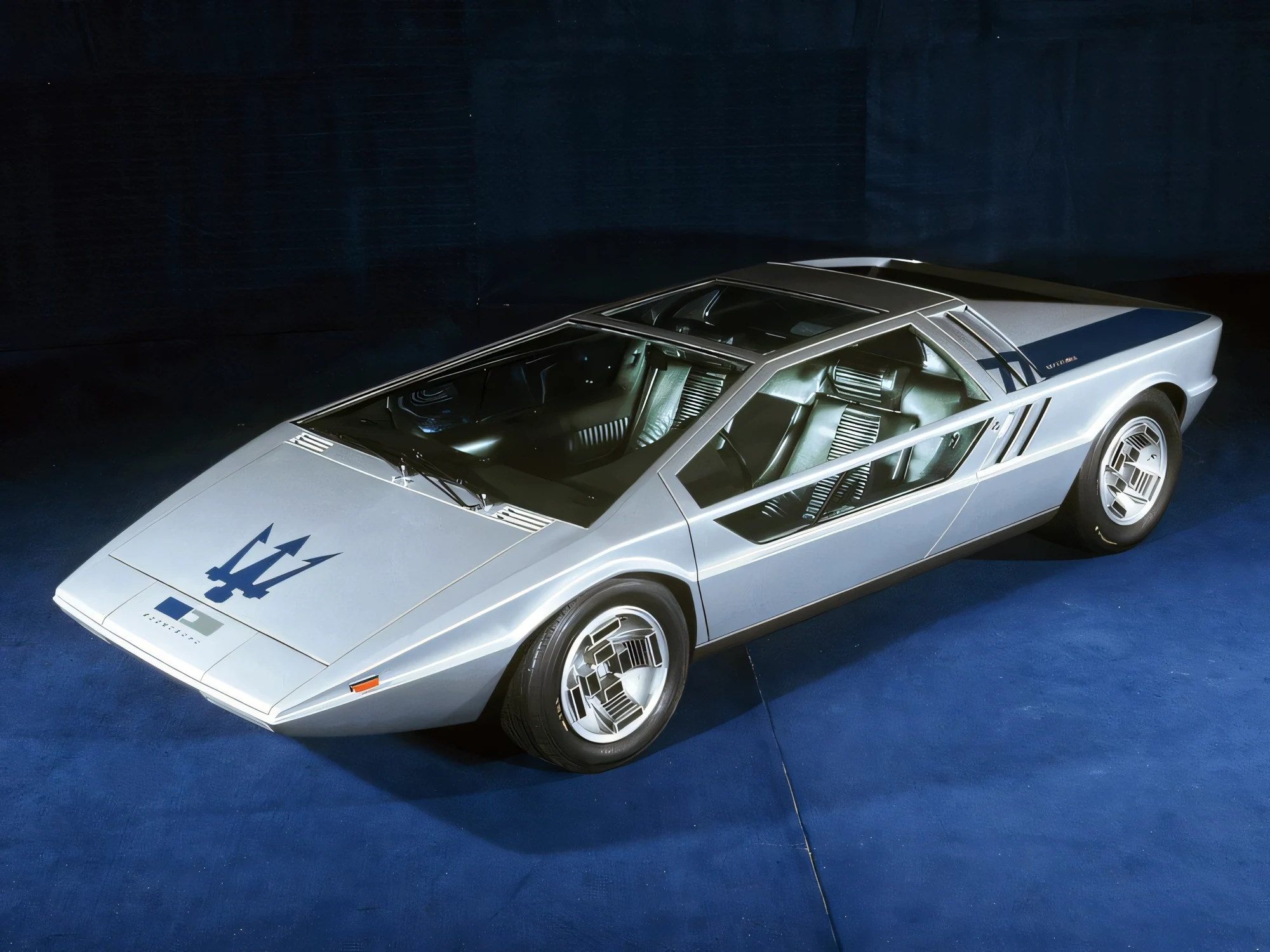
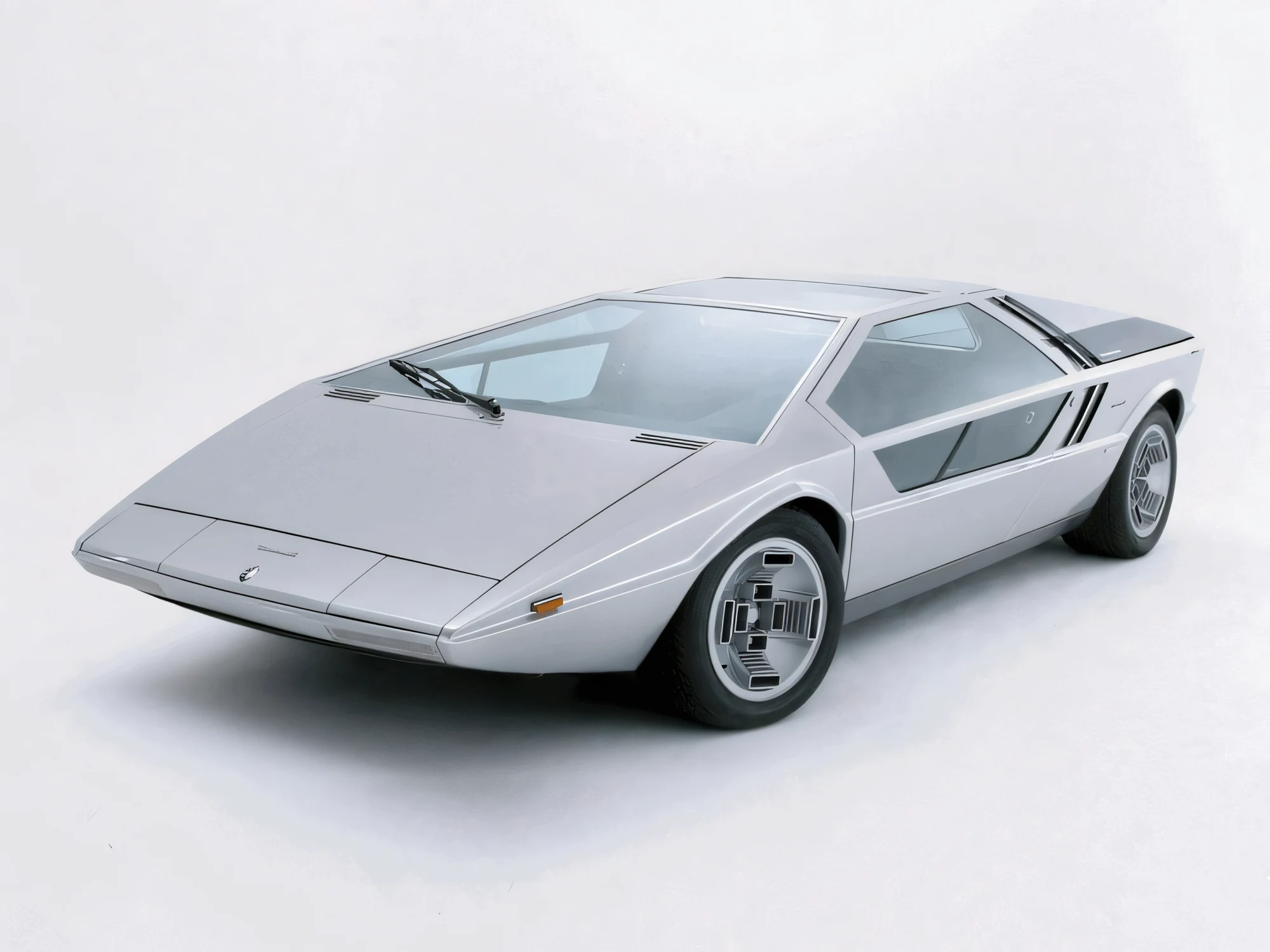
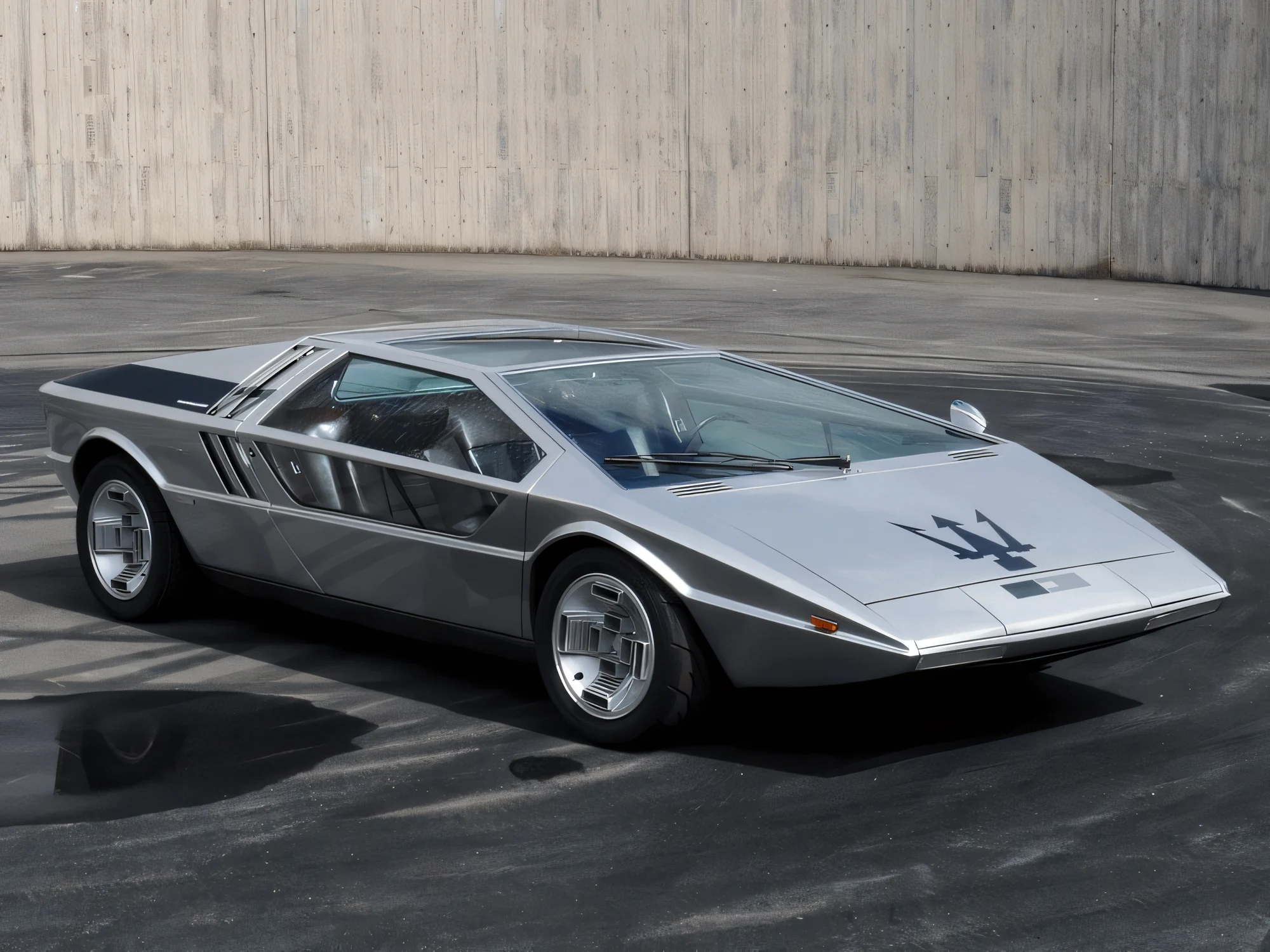
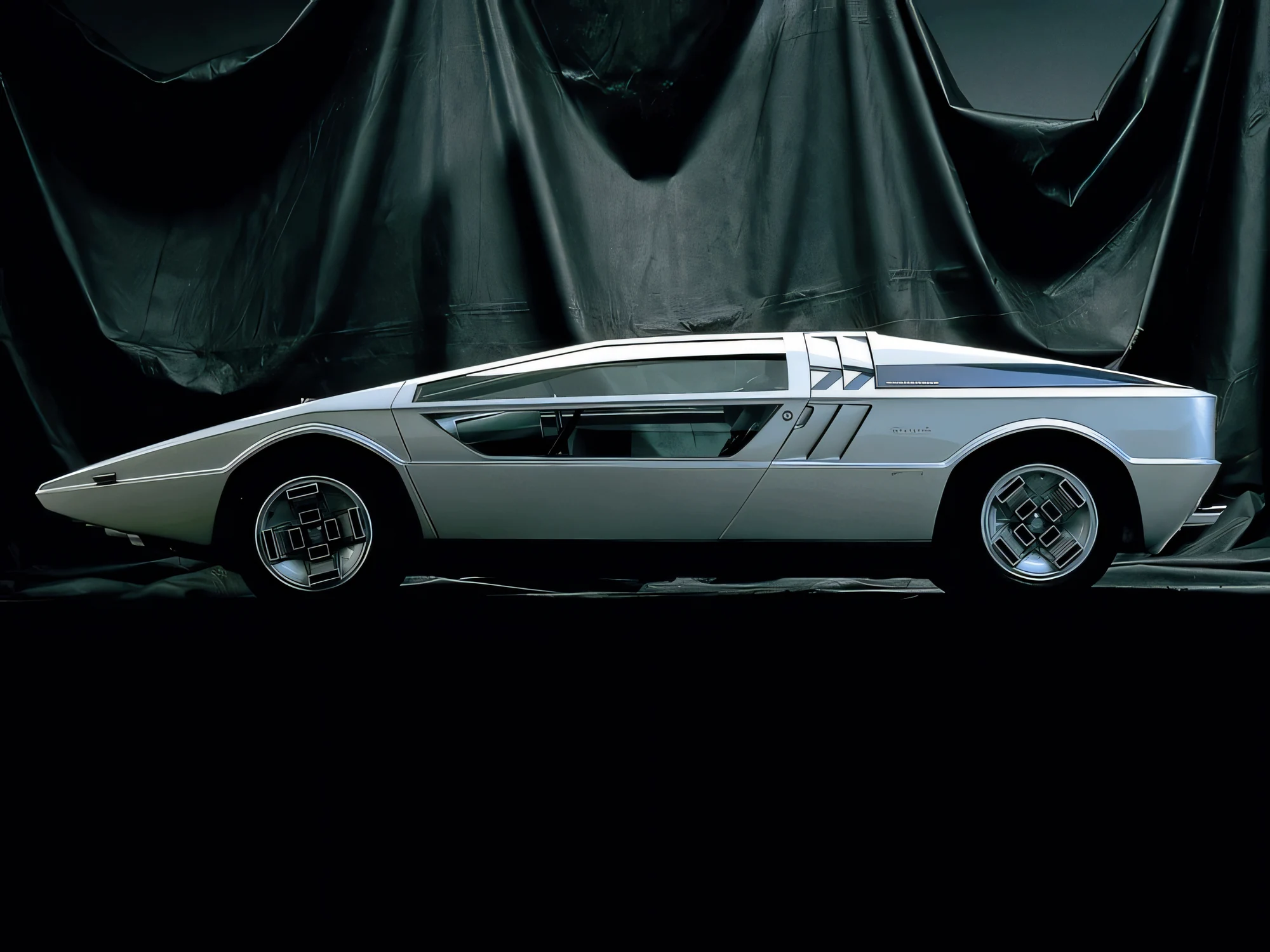
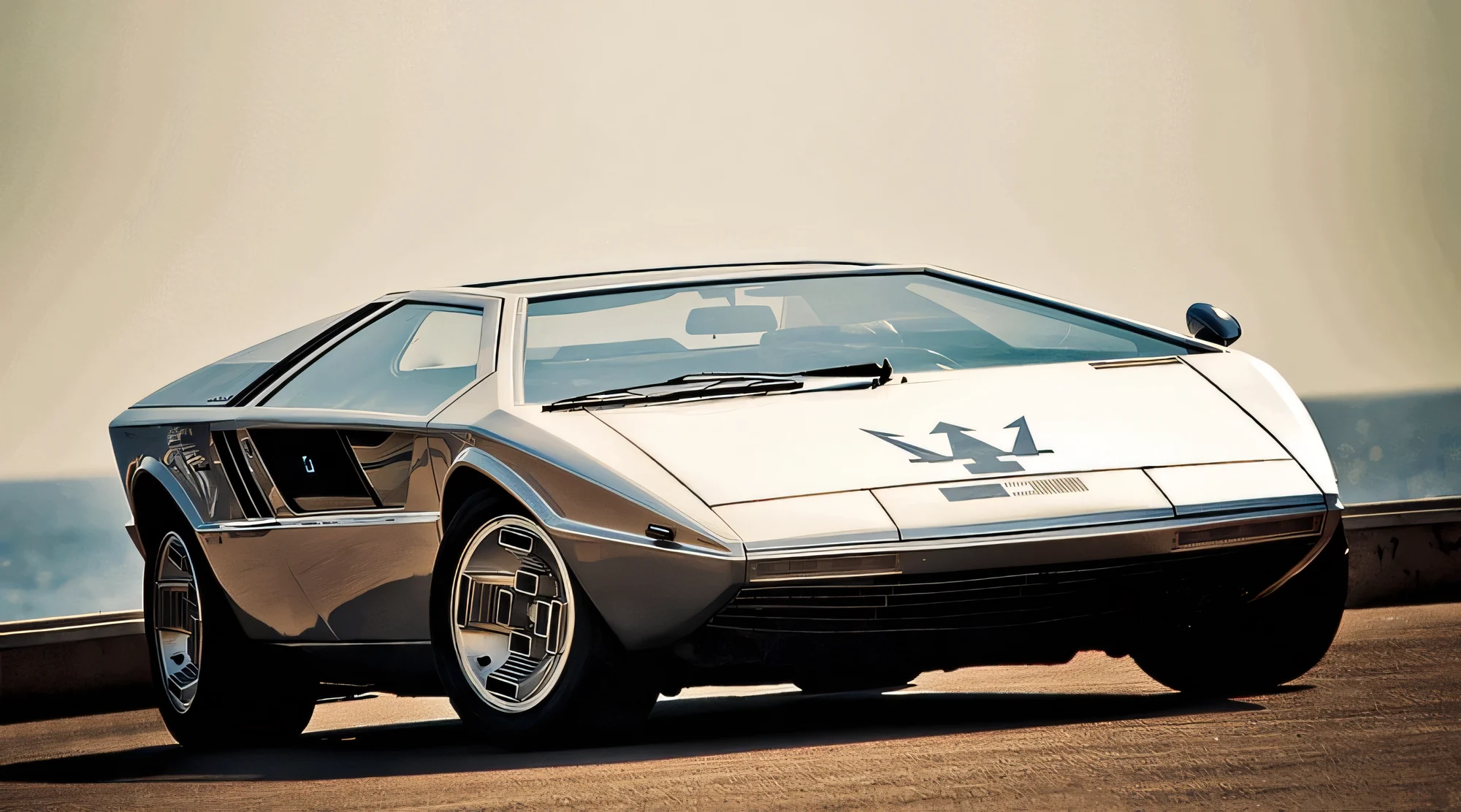
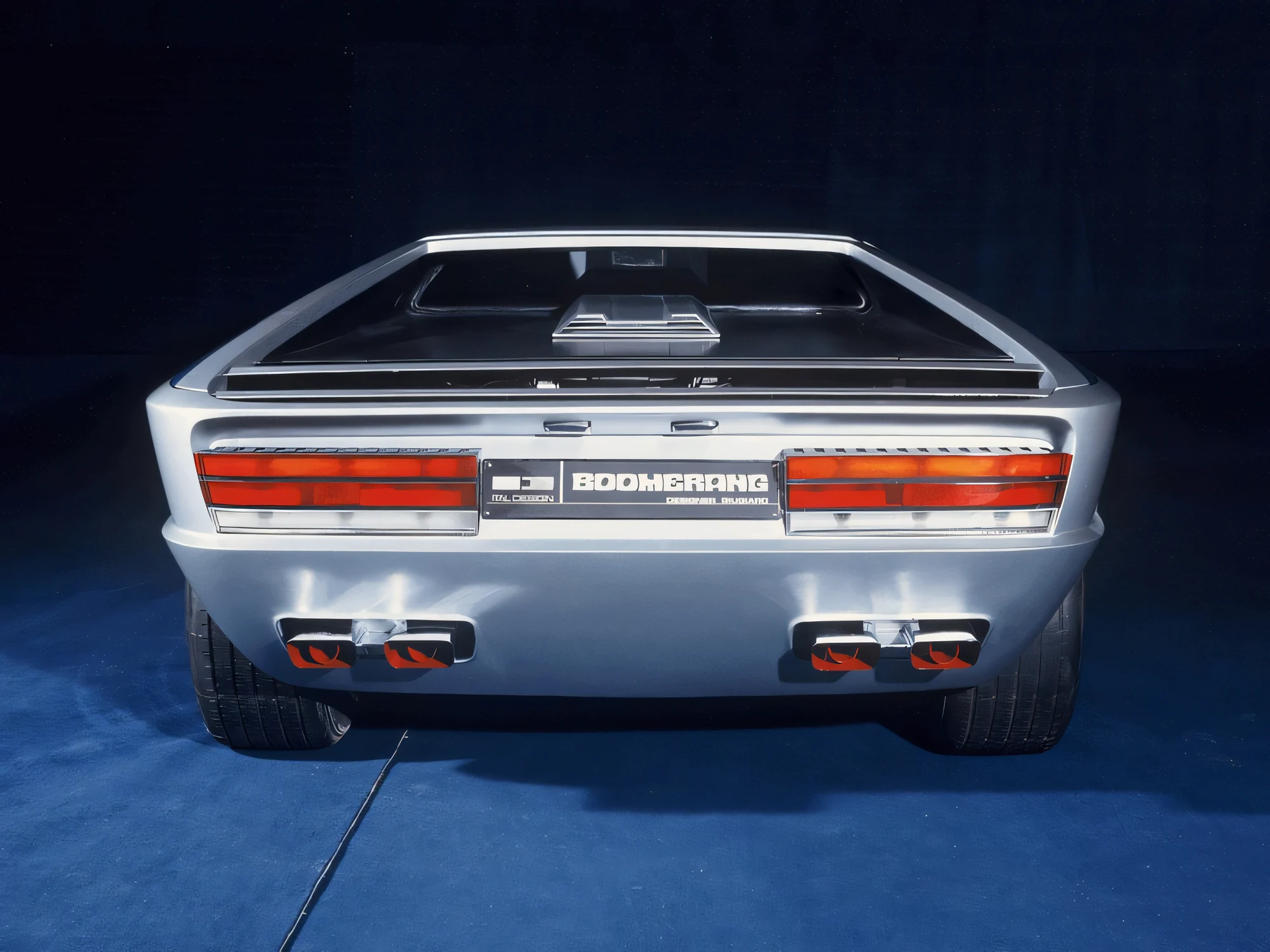
If the Marzal was Gandini making theatre, the Boomerang is Giugiaro making a point with a straightedge. It is the folded-paper wedge taken to its absolute limit — a Maserati reduced to a handful of intersecting flat planes, so severe that the bonnet and the windscreen read as one continuous surface. And unlike most show cars, it wasn't a sculpture: it ran, it was road-legal, and there was a real Bora V8 behind the seats.
- It's the purest folded-paper wedge ever built — the whole front is one unbroken flat plane, hood and windscreen reading as a single surface raked at just 13 degrees.
- Its steering wheel spun around its own instruments: a fixed central binnacle of gauges the driver read through a rotating rim — with a chain on the column and a space left for an airbag, in 1972.
- Not a styling buck — a real, road-registered running car on a Maserati Bora, which sold at Bonhams in 2015 for around €3.3 million.
Most concept cars soften on the way to the show stand — a wild idea rounded off into something
palatable. The Boomerang did the opposite. Giugiaro drew the sharpest shape of his life, built it
for real on a Maserati Bora, registered it for the road, and dared anyone to call it impractical.
It is the folded-paper wedge with nothing rounded off, and half a century later it still looks like
it arrived from a decade that never happened.
A car reduced to flat planes
The whole design is an argument that a car can be made of straight lines. There are almost no curves
on the Boomerang — just intersecting flat planes meeting at hard edges, the front of the car a single
surface from nose to roofline. The specific moves that make it work — the 13-degree screen, the
trapezoidal glass, the binnacle steering wheel — are catalogued above; what matters is the totality,
the sense of a shape drawn with a straightedge and refusing to apologise for it. This was the purest
the style ever got, before or since.
Built to be driven, not just paraded
The Boomerang’s quiet flex is that it wasn’t a sculpture. Under the origami sits a complete Maserati
Bora — mid-mounted V8, real gearbox, real brakes — so the car could be, and was, driven on the road.
That changes what the design means. A static buck can promise anything; a running car has to package
an engine, a cooling system, pedals and a driver inside those uncompromising planes and still work.
Giugiaro made the maddest shape of the era and then proved it could function. The numbers behind it
are in the panel above, carrying the usual one-off asterisk — claimed, never tested.
The wedge that went to work
The Boomerang never reached production, and was never meant to. Its job was to establish a language —
and that language then spent the next ten years in showrooms. The discipline that made the Boomerang
buildable is exactly what let Giugiaro turn the same geometry into the Golf, the Esprit and a
generation of cars people actually bought. A concept’s real output is influence, and the Boomerang’s
influence you could park on your driveway.
The designer Giorgetto Giugiaro — Car Designer of the Century
It isn't hyperbole: in 1999 Giugiaro was formally voted Car Designer of the Century. Born in 1938, he had been chief stylist at Bertone — where, in a neat twist that ties this file to another, he was succeeded by Marcello Gandini, the man who drew the Marzal — then spent time at Ghia before co-founding Italdesign in 1968 with the engineer Aldo Mantovani.
What made Italdesign different from the old carrozzerie is that it didn't just style cars, it engineered them for mass production. The VW Golf, the Lotus Esprit, the DeLorean, the Fiat Panda, the BMW M1 — all Giugiaro, all built in their millions or made icons. The Boomerang is the pure-concept distillation of that same rational, folded-paper geometry, drawn before it was quietly fed into a decade of showroom cars.
Where Gandini's wedge was theatrical, Giugiaro's was disciplined — straight lines, flat planes, buildable surfaces. The Boomerang is him pushing that discipline as far as it could physically go, and then driving the result home.
Also from Giugiaro Maserati Bora1971Maserati Merak1972VW Golf Mk11974Lotus Esprit1976BMW M11978DMC DeLorean1981
The design language
The cues that make it what it is — and why each one was drawn that way.
The plane One surface, nose to screen
The defining trick of the folded-paper style, taken to its limit: an almost unbroken flat plane runs from the very tip of the nose, up over the bonnet and straight into the windscreen, with no visible break. The hood and the glass read as a single continuous surface — the car looks less sculpted than folded.
The screen A 13-degree windscreen
The windscreen is raked at just 13 degrees — a full two degrees shallower than Giugiaro's own Bizzarrini Manta of 1968, and about as flat as glass gets. Its trapezoidal shape then set the geometry for everything behind it: the side glass, the rear screen and the heavy rear buttresses all follow from that one angle.
The wheel A steering wheel that spins around its dials
The Boomerang's most-copied idea. The instruments didn't turn with the wheel — they sat in a fixed central binnacle the driver read straight through the rim: speedometer and rev counter up top, light/wiper/indicator switches in the middle, minor gauges below. The rim and spokes rotated around that stationary pod, the oversized column hiding the pivot.
The details Safety from the future
Extraordinary for a 1972 show car: the steering column was retained by a chain so it couldn't spear back toward the driver in a crash, and space was deliberately reserved inside the hub for an airbag — both years before either became normal. The Boomerang was a design exercise that quietly took occupant safety seriously.
Design deep cuts
Was the Boomerang a running car, or just a styling model?
Both, at different shows. The version that debuted at the Turin Motor Show in 1971 was a non-running full-size model made of 'Epowood', a composite. The car reappeared at the Geneva Motor Show in March 1972 as a fully functional, road-registered running car built on a real Maserati Bora chassis — and it remains driveable today.
How did that steering wheel actually work?
The instrument cluster was fixed and the wheel moved around it. A central binnacle held all the gauges and switches in place — speedo and tacho at the top, switchgear in the middle, minor gauges at the bottom — while the steering wheel's rim and spokes rotated around that stationary pod, which the driver read through the wheel. The unusually fat steering column concealed the mechanism. It's the single feature everyone remembers.
How steep is that windscreen, really?
Thirteen degrees from horizontal — roughly two degrees flatter than Giugiaro's earlier Bizzarrini Manta, and shallow enough that the glass reads as a straight continuation of the bonnet rather than a separate screen. That single angle is what makes the whole car look like one folded plane.
What's actually underneath it?
A Maserati Bora. The Boomerang uses the Bora's running gear — a 4.7-litre (4,719 cc) Maserati V8 fed by four Weber carburettors, a claimed 310 hp, and a five-speed gearbox — which is why it's a genuine driver and not a pushmobile. As with any one-off show car, those performance figures are period manufacturer claims, never independently tested.
Did the Boomerang influence real production cars?
Yes — most directly, its extreme shallow-screen work helped make the near-flat 18-degree windscreen of the 1976 Lotus Esprit possible, a rare case of a concept's wildest feature reaching a production car. More broadly, the folded-paper language the Boomerang perfected runs through a decade of Giugiaro's showroom designs.
Where is the Boomerang now, and what is it worth?
The one-off survives. After its show life it went into private hands, was refurbished in the early 2000s and road-registered in France, and then sold at Bonhams' Chantilly sale on 5 September 2015 for around €3.3 million — Bonhams calling it 'the signature concept car of the 1970s'.
More from the drawing board